

Every organization now runs on a mix of people, technology (this includes AI), and process — and that mix is rewriting the rules of how work gets done. Workflows are shifting, roles are blurring and the org chart that made sense last year might look entirely different next quarter.
Most leaders are assessing these changes with traditional metrics. But those measurement tools were built for a workplace where people did all the heavy lifting. To understand where AI is creating value (and where it isn’t) leaders must answer a new set of questions.
7 questions leaders must answer
The challenge isn’t finding more AI tools. It’s understanding how AI is changing the way work happens across your organization.
1. How is AI changing the way work actually gets done?
AI adoption has already reached a tipping point. ActivTrak’s 2026 State of the Workplace report found 80% of employees now use AI tools at work. Usage increased eightfold over two years and consistent monthly adoption averages 92%. But the most important finding isn’t how many people use AI. It’s that AI is changing work, making it essential to understand how these tools reshape workflows and collaboration.
The answer lies in how work flows across people, process and technology. The more employees use AI, the more responsibilities shift and new patterns of work emerge. By assessing these changes, leaders identify what’s working and uncover new opportunities. It’s how organizations prepare to guide teams through the next phase of AI transformation.
2. Which teams are adopting AI — and which are falling behind?
Adoption is rarely uniform. Some teams embrace AI immediately while others barely use it. Those differences reveal more than training gaps. They highlight where AI naturally fits into existing workflows, where additional support is needed and where opportunities remain untapped.
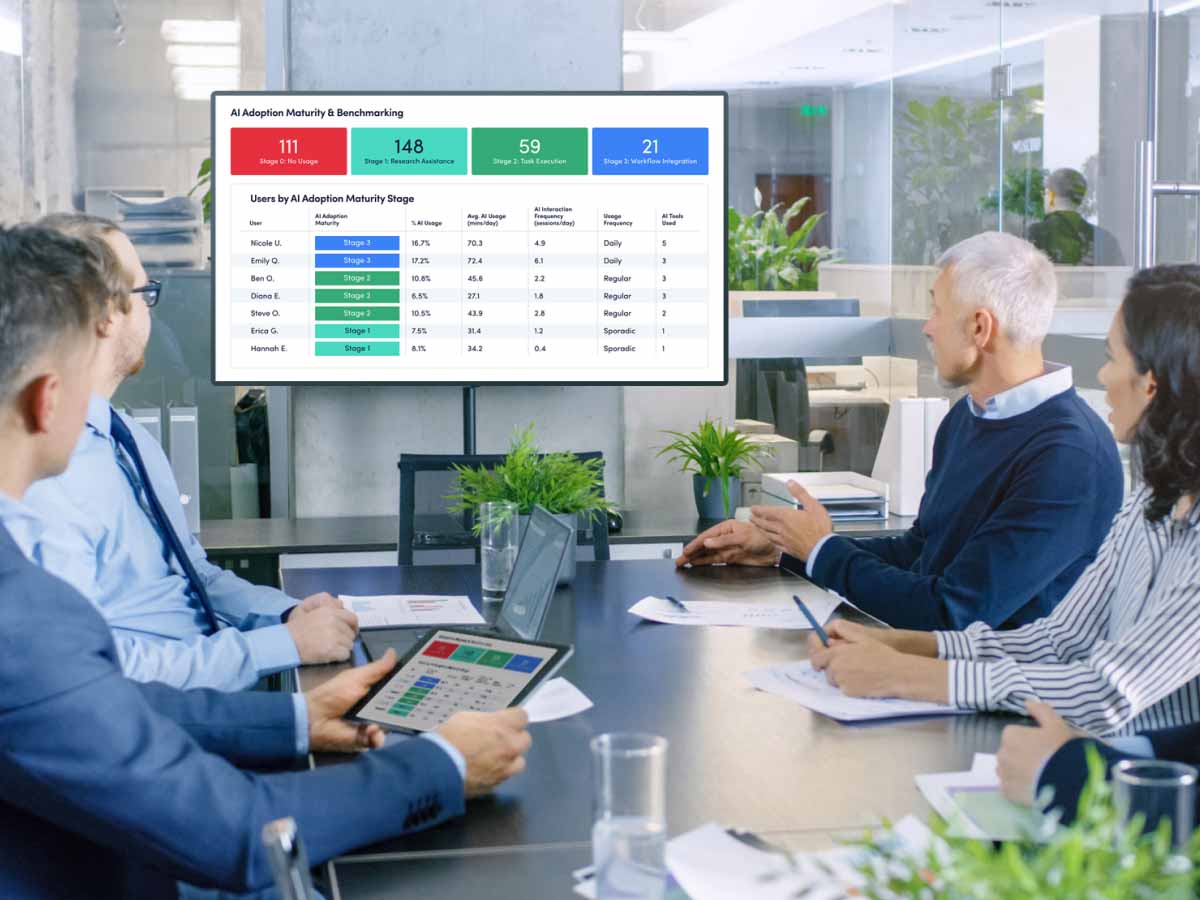
Knowing where AI is used is only the first step. Leaders also need visibility into how deeply AI is embedded into everyday work. Measuring AI adoption maturity with a tool like ActivTrak AI Insights reveals whether employees are still experimenting with AI or consistently integrating it into workflows. ActivTrak’s AI Adoption Maturity Model gives organizations a practical framework for benchmarking progress and moving teams toward workflow transformation.
3. Is AI improving output or simply creating more activity?
Using AI doesn’t automatically improve performance. Leaders need to see if AI empowers employees to complete more meaningful work, improve quality or accelerate outcomes. Otherwise, it’s impossible to distinguish genuine productivity gains from another layer of activity.
The data suggests there’s a difference between using AI and using it well. The 2026 State of the Workplace found employees who spend 7% – 10% of their work hours using AI achieve the highest productivity levels — yet only 3% of employees currently operate within this range. Answering this question tells you where to focus efforts so teams reach the productivity sweet spot.
4. Is AI freeing capacity — and how are teams using it?
One of AI’s biggest promises is giving employees time back. The real question is what happens next. Are teams reinvesting that capacity into innovation and customer outcomes, or are the savings disappearing into new meetings, administrative tasks and digital busywork?
In ActivTrak’s 2026 State of the Workplace report, every category of work increased for employees who adopted AI. Time spent in email, chat, messaging and business management tools increased as much as 145%. Rather than replacing work, AI often amplifies it. This makes it even more important to measure AI impact and see if additional capacity creates value.
5. Where is AI improving work, and where is it adding complexity?
Not every AI initiative delivers the same results. Some eliminate repetitive work, improve decision-making and increase output. Others add review cycles, duplicate existing processes, require more coordination or introduce tools that employees struggle to integrate into daily workflows. Measuring both value and friction helps leaders identify what should be scaled, redesigned or stopped.
According to ActivTrak Productivity Lab AI Adoption Maturity 1H 2026 Findings, only 2% of employees have reached the Stage 3 of AI adoption maturity (workflow integration), where AI is consistently embedded into everyday workflows. By measuring AI maturity alongside workforce performance, organizations distinguish between isolated productivity gains and sustainable business impact, and identify where additional tools or processes create unnecessary friction.
6. Which AI investments are delivering measurable returns?
As AI adds to already-crowded technology stacks, leaders need clear evidence their investments deliver results. Connecting technology usage with workforce outcomes makes it possible to identify which tools improve performance, which need stronger adoption and which no longer justify the cost.
Understanding AI ROI requires more than tracking licenses or login activity. Leaders need to connect AI usage with measurable business results such as productivity, utilization and workforce capacity. By combining AI adoption data with workforce analytics, organizations gain a clearer picture of which technologies improve performance, which require additional enablement and where investments deliver the greatest return.
7. What should we scale, redesign or automate next?
Organizations that measure how work actually happens are better equipped to identify the highest-value opportunities. They know which tools are worth the investment, where workflows should be redesigned and which automation opportunities are most likely to produce measurable value.
The organizations leading the next wave of AI transformation will use Work Observability to capture behavioral signals across people, process and technology, creating a continuous, cross-tool view of how work gets done. They will then apply Work Intelligence to turn those signals into actionable automation improvements.
AI is changing work. It’s time to change how you measure it.
There’s no question AI is reshaping workflows, shifting workforce capacity and changing how organizations create value. The leaders who succeed won’t simply deploy more AI. They’ll understand how work is changing, measure what matters and use those insights to make better decisions about people, technology and operations.
Ready to understand how AI is changing work across your organization? Request a demo to see how ActivTrak helps you measure AI adoption, assess its impact on productivity and capacity and make more informed decisions about people, technology and operations.