

Table of contents
- Why AI adoption maturity matters more than AI usage
- The 5 stages of ActivTrak’s AI adoption maturity model
- What the data says about AI adoption maturity
- Using behavioral data to identify AI adoption maturity stages
- What to expect in the early stages of AI adoption maturity
- 3 mistakes that slow AI adoption maturity
- 3 levers to accelerate AI adoption maturity
- How to recognize AI maturity progress
One company deploys new AI tools across every department. Another takes the time to redesign workflows and develop new ways of working. The difference? One is experimenting. The other is intentional about changing how work gets done.
That’s the difference between AI usage and AI adoption maturity. While many organizations track licenses, logins and prompts, those metrics reveal very little about whether AI improves productivity, reshapes workflows or creates measurable business value.
Understanding where your teams fall on the AI adoption maturity curve helps you set realistic expectations, prioritize investments and create lasting business impact. The ActivTrak Enterprise AI Adoption Maturity Model defines five stages organizations move through as AI evolves from experimentation to workflow transformation.
Key takeaways:
- AI adoption maturity measures how work changes, not how often employees use AI.
- Most organizations are still in the early stages of AI adoption, even after rolling out AI tools.
- ActivTrak’s AI adoption maturity model helps leaders understand how organizations progress from AI experimentation to workflow transformation.
- Behavioral data reveals progress more accurately than AI licenses, logins or prompt counts.
- Early productivity dips are often a sign of progress as teams shift work to AI before workflows fully adapt.
- Organizations advance faster when they redesign work, tailor enablement to each maturity stage and measure behavioral change.
- The companies that realize lasting AI value build operational discipline — not just bigger AI tech stacks.
Why AI adoption maturity matters more than AI usage
To understand why AI adoption maturity is so important, consider BCG’s research across 1,250 executives in 68 countries. Companies in the top 5% on AI maturity achieved 3.6x higher three-year total shareholder return than laggards. The same study found that 60% of organizations with active AI use report minimal revenue and cost gains.
The difference between those two groups isn’t which tools they use. It’s how mature their use of those tools is.
The correlation between where a team sits on the AI adoption curve and their productivity metrics, KPI attainment and capacity utilization is measurable and significant.
But most maturity frameworks live in analyst research or product roadmaps showing what a technology can do. This is useful for evaluating vendors, but not when it comes to making decisions about people, investment and progress.
Leaders who understand AI adoption maturity can set realistic expectations, invest in the right capabilities at the right time and distinguish meaningful progress from simple activity.
That last distinction matters more than it might seem.
Additional BCG research found employees with clear strategic direction but limited AI tool access reported measurable productivity impact 80% of the time, compared to 60% for those with strong tool access but no strategic clarity. That’s twenty points of difference driven by how intentionally AI is embedded in work — not which tools are available.
Traditional usage metrics rarely reveal that gap. Understanding how AI changes work does.
AI adoption maturity is often discussed as a technology problem. In practice, it’s a work design problem. The defining question at each stage isn’t what AI can do. It’s how responsibility shifts between humans and AI as trust, process discipline and organizational capability evolve. Viewed through this lens, maturity reflects the gradual shift from experimentation to operational integration and, ultimately, transformation.
The 5 stages of ActivTrak’s AI adoption maturity model
Once users move past stage 0 (no AI usage), AI adoption maturity progresses across five stages grouped into three phases: exploration, augmentation and transformation.
Phase 1: Exploration
In this phase, employees begin learning where AI fits into their work while most tasks and workflows remain unchanged.
Stage 1: Research Assistance
During this stage, employees consult AI for knowledge but don’t delegate work to it. AI tools serve as a more sophisticated search engine: useful for answering questions, summarizing information and accelerating research, but not yet integrated into how work gets done.
Use is sporadic, with little to no workflow integration. A small group of employees may use AI frequently, while most engage only turn to it occasionally. Time allocation remains largely unchanged because AI has not yet altered underlying work patterns.
AI ROI is typically negative at this stage, with little to no productivity gains. Organizations are building familiarity and confidence with the technology, but productivity gains tend to be isolated and inconsistent. The learning investment has begun but not yet compounded into measurable business impact.
Stage 2: Task Assistance
In the second stage, AI contributes directly to tactical work outputs by helping employees draft content, structure information, generate ideas and complete routine tasks. Humans remain responsible for validating, refining and finalizing the work.
The behavioral signature is more consistent usage within specific functions and activities, but usage remains task-based rather than workflow-based. AI helps employees complete individual tasks faster, but does not yet fundamentally change how work moves through the organization.
Early but inconsistent ROI signals begin to emerge at this stage. Individual productivity improves, but gains are often localized and dependent on the habits of specific employees or teams rather than being broadly scalable.
Phase 2: Augmentation
In the augmentation phase, AI becomes part of everyday workflows.
Stage 3: Workflow Integration
This is the inflection point where AI shifts from a productivity tool to an operational capability. Rather than supporting isolated tasks, AI is embedded across multiple steps of a workflow. Humans continue to define intent, review outputs and approve results, while AI increasingly contributes to execution.
The behavioral signature is consistent AI usage across multiple tools, activities and teams. AI is no longer an add-on. It’s integral to how work gets done. Time allocation begins shifting away from lower-value execution tasks toward higher-value analysis, decision-making and problem-solving.
This is where organizations begin to see measurable improvements in activity efficiency, capacity utilization and KPI attainment. The benefits of AI start compounding because usage is no longer dependent on isolated employee behavior.
Phase 3: Transformation
Work is redesigned around AI in the final phase, shifting people from task execution to oversight and improvement.
Stage 4: Guided Automation
At this stage, AI begins executing portions of multi-step workflows with limited human intervention. Employees shift from directing individual tasks to managing agents, defining strategies, setting priorities and continuously improving workflows.
Meaningful redistribution of work to AI starts to happen. Routine execution decreases while time spent supervising outcomes, resolving exceptions and optimizing processes increases. Reaching this stage requires more than AI proficiency. It requires standardized processes, clear decision rules and governance mechanisms that support automation.
Organizations at this stage can unlock substantial efficiency gains, but only when process maturity advances alongside AI maturity.
Stage 5: Full Automation
In the final stage of adoption maturity, AI operates workflows within clearly defined guardrails, handling the majority of execution while humans maintain responsibility for governance, risk management and accountability.
There’s minimal human involvement in routine operations and increased focus on monitoring outcomes, managing exceptions and refining systems. Few organizations operate broadly at this stage today, and most examples remain limited to highly structured processes with clear objectives and controls. It requires the concerted effort of operations and transformation teams that have redesigned work and purposely balanced the jobs and responsibilities of human workers vs. AI agent workers.
This distinction matters because many transformation initiatives are built around stage five aspirations while the organization still operates with stage one or stage two behaviors.
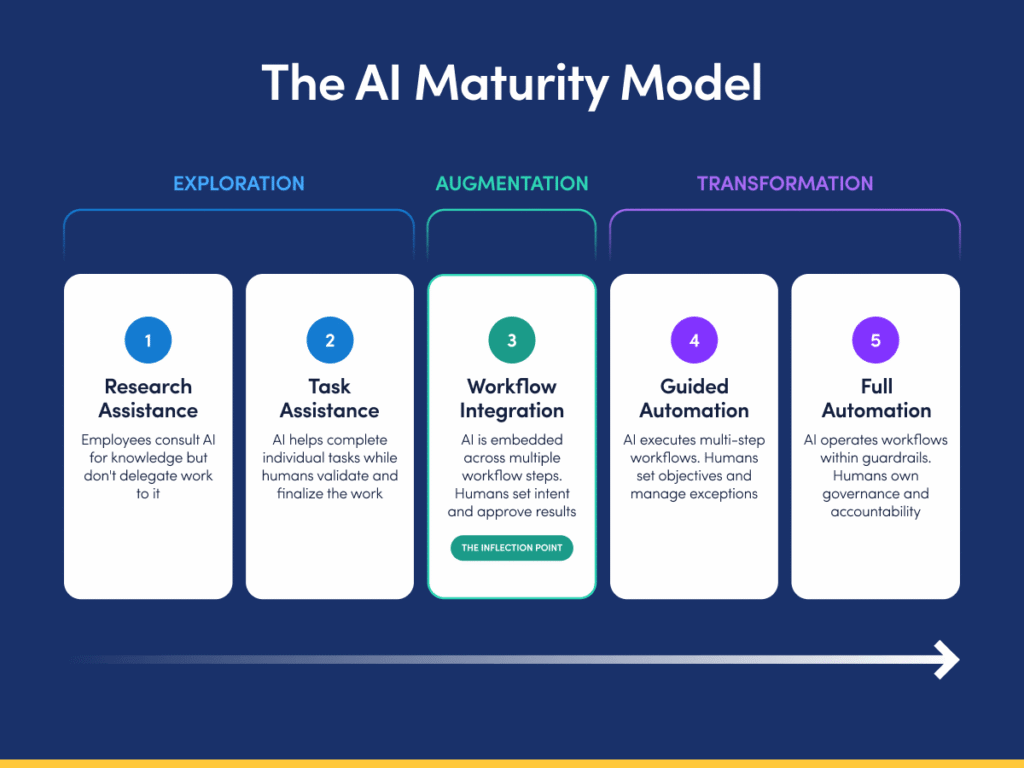
Organizations that create durable value from AI typically don’t skip stages. They progress through them deliberately, building the operational discipline and organizational capability required at each step.
What the data says about AI adoption maturity
The AI maturity model framework is straightforward. Determining where an organization sits on it is harder.
The challenge is largely a measurement problem. Traditional usage metrics show whether employees use AI but reveal far less about whether AI changes how work gets done. This is where behavioral data becomes critical. Indicators such as workflow integration, shifts in time allocation and improvements in high-value work and task efficiency provide a much more accurate picture of AI maturity.
Viewed through this behavioral lens, most organizations are concentrated in stages one and two. ActivTrak’s State of The Workplace Report analyzed 1,111 organizations and showed employees use AI. But for most teams, it has not yet become part of how work gets done.
Other research points to the same conclusion. Gallup’s April 2026 survey of 23,717 U.S. employees found 65% of workers at AI-adopting organizations say AI has improved their personal productivity. But only about one in ten strongly agree it’s fundamentally transformed how work happens across their organization.
Individual productivity gains and organizational transformation are not the same thing. The data suggests some organizations have achieved the first without the second.
Using behavioral data to identify AI adoption maturity stages
Defining the stages of AI adoption maturity is relatively straightforward. The harder challenge is determining where teams sit on the curve, and whether they’re progressing. AI adoption maturity often varies significantly across functions, teams and roles, making organizational averages less useful than leaders might assume. It’s rarely uniform — and that variation is why behavioral data is so important.
Because AI adoption maturity isn’t an organizational average. It’s a distribution.
When organizations begin measuring maturity across teams and functions, they rarely find uniformity. They find variation. And that variation often reveals more than organizational averages ever could.
The instinct is to ask: “What stage has my organization reached?” It’s the wrong question. The more useful one is: “How does AI maturity vary across our teams and roles?”
ActivTrak data from a financial services organization illustrates this clearly. Across seven banking functions — all operating under the same AI rollout with access to the same licensed tools — AI adoption maturity varied significantly by team.
- Risk Management had 20% of its users at stage zero.
- Retail Banking had 45%.
- Wealth Management was somewhere in between at 25%.
Some variation is expected. Different functions adopt AI under different operating conditions. A customer service team working within highly standardized processes faces a different adoption path than a relationship-driven sales organization or a risk management team operating under stricter governance requirements.
The goal of maturity measurement isn’t to eliminate variation. It’s to understand which variation reflects legitimate business realities and which reflects barriers that can be addressed.
A company-wide average would obscure this. A function-level distribution surfaces it in a way that drives decisions. It tells leaders where to concentrate enablement investment, which teams are ready to advance and which need foundational work first.
The picture becomes even more useful when tracked over time. In the same organization, the share of users at Stage 0 declined from 43% to 29% over six months as enablement efforts took hold — a 14-percentage-point shift that wouldn’t be visible in license utilization data, but is unmistakable in behavioral data. That’s maturity progression made measurable.
The next question is what happens to outcomes as teams move through those stages.
What to expect in the early stages of AI adoption maturity
When manufacturers adopted electricity in the late 1800s, productivity didn’t immediately improve. Factory owners replaced steam engines with electric motors but kept the same layouts — centralized power sources, equipment in fixed positions. The technology changed, but the work design didn’t. It took nearly two decades of factory floor redesign before the full productivity gains of electrification materialized.
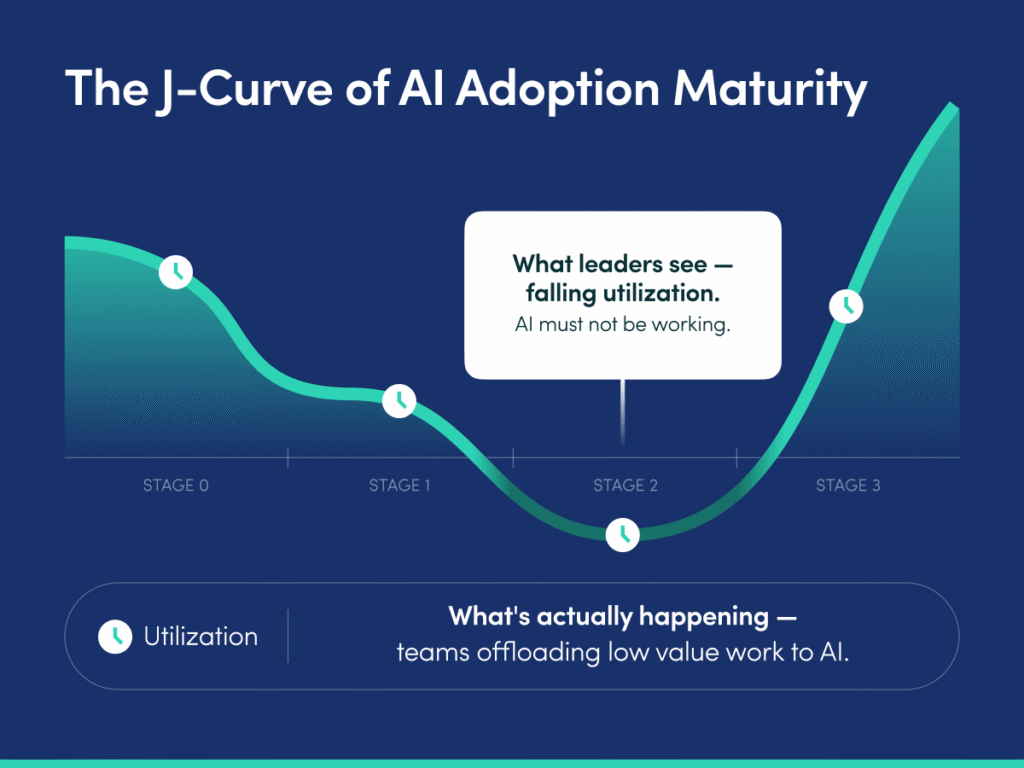
A similar J-curve pattern shows up in AI adoption data today.
In a customer service organization ActivTrak analyzed, the stage zero baseline showed high workforce utilization and lower efficiency — teams working hard but not yet working differently. As users moved into stage one, utilization began to decline. By stage two, that decline was significant. Most leaders see that dip and read it as a failure signal. It isn’t.
Declining utilization in early stages means teams are beginning to offload lower-value work to AI. They haven’t yet redesigned workflows to capture the freed capacity — but the reallocation has started.
Interpreting that dip as a productivity problem is the same mistake 19th-century factory owners made when they concluded electrification wasn’t working because output didn’t jump in year one.
By stage three, the pattern shifts:
- Utilization stabilizes.
- Core efficiency improves significantly.
- Performance outcomes begin to follow.
The compound effect of workflow integration starts appearing in the data, the same way factory productivity eventually accelerated once the redesign was complete.
This is the J-curve of AI adoption. Organizations that interpret the early stage utilization dip as evidence AI isn’t working — and pull back investments — exit the curve right before the gains compound.
Part of the challenge is that technology adoption and organizational change operate on different timelines. AI capabilities can be deployed quickly. Workflow redesign, role adaptation and new operating norms take much longer.
As a result, teams often move through the maturity curve at different speeds, creating a temporary gap between what the technology can do and what the organization is prepared to absorb.
Without visibility into that progression, leaders struggle to distinguish between teams that are advancing, teams that are stalled and teams that require additional support. Behavioral measurement makes those differences visible, helping organizations focus interventions where they have the greatest impact and accelerate progress through the curve.
The leaders who navigate this well are the ones who understand what they’re looking at. Utilization metrics alone tell you that something changed. Behavioral data tells you what changed and whether it’s moving in the right direction.
The skills gap inside the data
One of the more counterintuitive findings from AI adoption maturity measurement is that most gaps aren’t about tool access. They’re about tool adoption.
Organizations pay for AI capabilities their teams don’t know exist or haven’t been enabled to use. The distance between “licensed” and “used meaningfully” is often significant and completely invisible to license activation data.
One example from ActivTrak’s platform data: In a sales organization, 74% of reps were not using AI for email and outreach drafting, despite having three AI tools licensed that provided exactly that capability. The tools were available but the behavior hadn’t changed. From a spend perspective, those licenses looked like adoption. From a behavioral perspective, they looked very different.
BCG’s 2026 AI at Work research adds context: Training satisfaction among employees remained flat at 36% for two consecutive years, even as frontline AI adoption jumped. Organizations are expanding AI access faster than they’re equipping people to use it. That structural gap between deployment and enablement is what maturity measurement surfaces.
This matters because the fix for a skills gap looks nothing like the fix for a tool access gap. Buying more AI licenses doesn’t solve a training problem. Understanding which teams are stuck at which stages — and why — is what points leaders toward the right intervention.
The spend signal
Maturity measurement also generates a valuable byproduct: spend intelligence. When you can see which tools drive behavioral change at stage three and which generate stage one activity at stage three prices, spend decisions become straightforward.
The question shifts from “are we investing enough in AI?” to “are we getting return on what we’ve already deployed?”
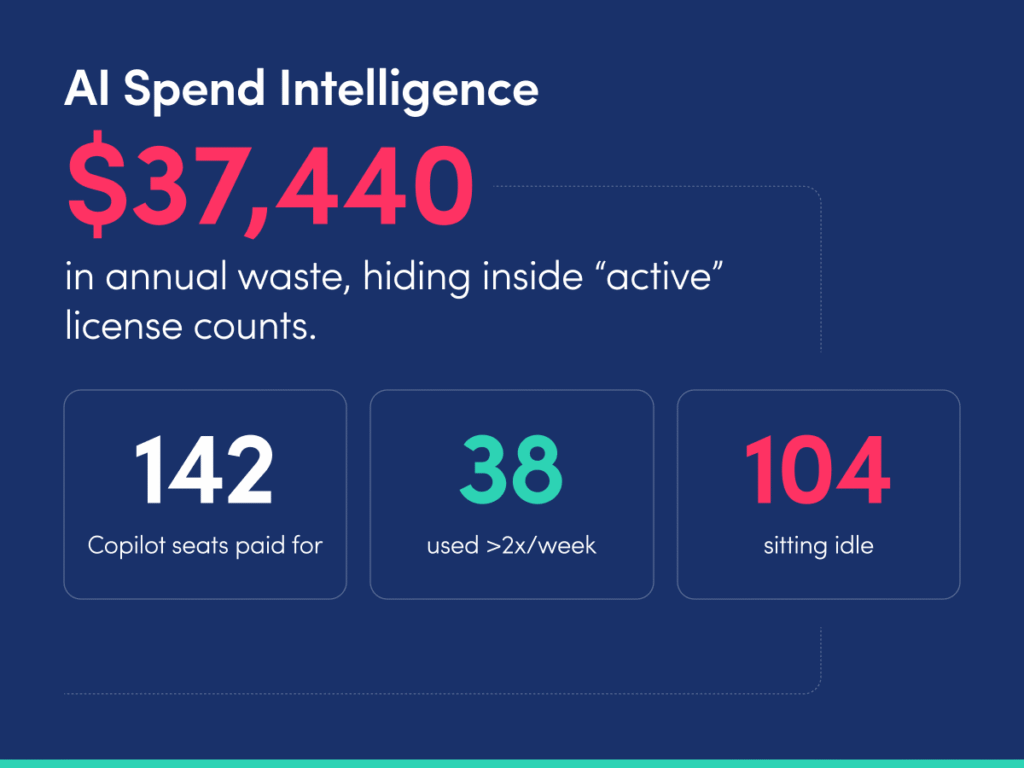
In one example, an organization paying for 142 Microsoft Copilot seats had only 38 users engaging with the tool more than twice a week. The estimated annual waste was $37,440. That number doesn’t exist in license data — it only appears when you layer behavioral measurement on top of spend data.
The inverse is equally important. Behavioral data can identify which tools drive meaningful engagement and workflow change, helping leaders direct investment toward technologies that accelerate movement up the maturity curve.
Most organizations carry some version of this waste.
The challenge isn’t that AI tools are a poor investment. It’s that license activation data creates the appearance of adoption without confirming it. Behavioral data closes that gap.
3 mistakes that slow AI adoption maturity
Teams have the tools. What they lack are the workflows, enablement and visibility to move up the curve.
Mistake 1: Treating all teams as if they’re at the same stage
Generic AI enablement programs produce generic results. The problem is that a team at stage one and a team at stage two need fundamentally different things, and what works for one may actively fail the other.
A stage one team needs to understand which tasks AI handles well. The goal is to build confidence and use case familiarity. A stage two team needs help turning sporadic AI usage into consistent workflow integration. A stage three team needs to identify what can be handed off entirely and how to redesign surrounding processes to make that handoff reliable.
One enablement program cannot do all three. Organizations that deploy a single AI training initiative across all functions are, at best, helping one segment and confusing all the rest.
Mistake 2: Conflating more tools with higher adoption maturity
Tool sprawl is one of the clearest signals of an organization stuck in early stages. The average organization now uses seven AI tools, and 83% use six or more. And yet behavioral data shows most of those organizations remain concentrated in stages one and two.
Adding a new tool to a team that hasn’t integrated the last one doesn’t advance adoption maturity. It creates noise. It fragments attention across platforms, dilutes enablement investment and produces the appearance of progress — more tools, more spend, more announcements — without changing how work actually gets done.
PwC’s 2026 AI Performance Study found that the top 20% of companies capture 74% of AI’s economic value — and that what separates them from the rest isn’t how many AI tools they’ve deployed. It’s whether AI is fully integrated into standard operating processes rather than layered on top of them.
Mistake 3: Measuring activity instead of behavioral change
Many organizations track training completion rates, feature activations and tokens. Those inputs show what employees did in a session. They don’t tell you whether AI shows up consistently in how work gets done — a key predictor of adoption maturity advancement.
This is the same distinction I highlighted in the first article between AI adoption and AI impact. Activity metrics capture participation. Behavioral metrics capture sustained behavior change. Employees can complete training, activate new features and log into AI tools without changing the way they approach their work. Activity metrics will suggest progress. Behavioral data will show whether progress actually occurred — and is a leading indicator for outcomes and performance.
3 levers to accelerate AI adoption maturity
Advancing AI adoption maturity is not a technology problem. It isn’t solved by deploying more tools, running another training program or adding AI features to existing licenses. It advances when leaders understand the specific bottlenecks that hold teams back, redesign work around AI and measure whether those changes take hold.
1. Visibility
Knowing a team’s maturity stage is useful. Understanding why it’s there makes that information actionable. Is low adoption maturity a training gap? A workflow design problem? An underutilized tool that nobody knows how to use? A cultural resistance signal?
Visibility turns maturity from a theory into a management discipline. Leaders can’t intervene effectively if they can’t see where teams progress, where they’re stalled or why.
Each of those diagnoses points to a different intervention. A training gap requires enablement. A workflow design problem requires process redesign. An underutilized tool requires targeted activation. Cultural resistance requires a different kind of leadership conversation entirely. Without behavioral data, they all look the same from the outside — and you end up applying the wrong fix to the right problem.
What holds a team back at stage one isn’t what holds a team back at stage three.
2. Stage-specific enablement
What helps a team advance at one stage may do very little at the next.
At stage one, the challenge is awareness and confidence. Employees may understand what AI is, but they have not yet identified where it consistently fits into their daily work. The goal is to help teams identify a small number of high-frequency activities where AI reliably saves time, improves quality or reduces effort.
At stage two, the focus shifts to consistency. Individual employees have found valuable use cases, but those practices remain uneven and difficult to scale. The challenge is no longer convincing people to use AI. It’s turning sporadic usage into repeatable habits and shared ways of working.
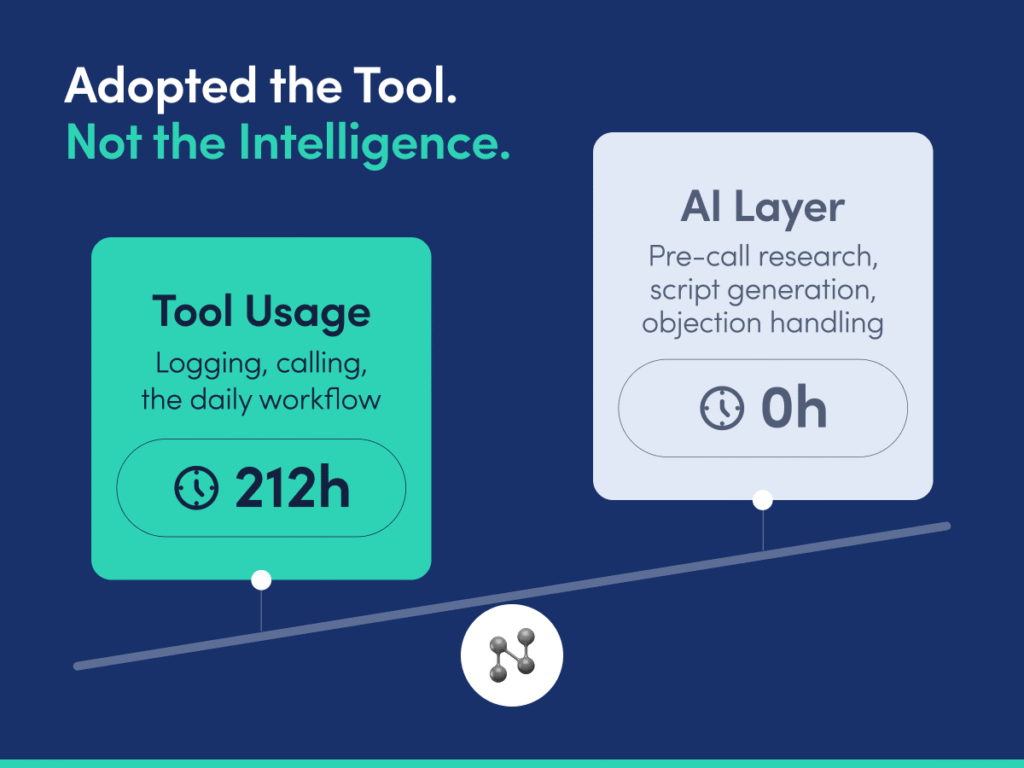
One example from ActivTrak’s platform data: an SDR team was spending 212 hours per month in Nooks — a tool with native AI features for pre-call research, script generation and objection handling — without activating any of those AI capabilities. The tool was embedded in their daily workflow but the AI layer within it wasn’t. That’s the stage two pattern precisely: Consistent tool usage that hasn’t yet crossed into consistent AI integration.
At stage three, workflow integration is the priority. AI already contributes to individual tasks, but workflows have not evolved to capture the full benefit. Teams must rethink how work moves through the process, how outputs are reviewed, which approvals still add value and where human involvement creates friction without improving outcomes.
By stage four, success depends on process discipline. Multi-step automation depends on clearly defined workflows, consistent decision rules and explicit exception handling. Teams that struggle to advance beyond stage three often face process variability rather than technology limitations.
At stage five, the emphasis shifts to governance and optimization. Once AI operates within established guardrails, the challenge is no longer execution. It’s ensuring accountability, managing risk, monitoring outcomes and continuously improving the system. Organizations that reach this stage need operating models that treat AI as part of the workforce rather than simply another tool.
KPI attainment is the outcome signal leaders and boards are ultimately looking for. It arrives later than efficiency gains and requires patience, but it’s the most durable evidence that AI adoption maturity produces business results.
Many organizations apply the same intervention at every stage. More training does not solve a workflow integration challenge. Additional tools do not solve a process discipline challenge. Governance frameworks do not solve an awareness challenge. Progress accelerates when leaders match the intervention to the team’s most pressing need.
3. Work redesign
The organizations that advance the fastest on the maturity curve share a common approach. Rather than asking where AI should be inserted into an existing process, they begin by examining how work moves through that process in the first place.
- Where does work stall?
- Which approvals create bottlenecks?
- Which decisions genuinely require human judgment?
- Which activities can be delegated without increasing risk?
- Which exceptions occur frequently enough to require a formal response path?
Those questions matter because maturity ultimately shifts responsibility. As teams move up the curve, employees spend less time generating outputs and more time defining objectives, reviewing outcomes and managing exceptions. The workflow itself changes.
This is why simply layering AI onto an existing process produces limited results. The process was designed for human execution. If every approval, handoff and review step remains unchanged, AI may accelerate individual activities without materially improving the overall workflow.
Deloitte’s 2026 Global Human Capital Trends research quantifies this directly: Organizations that prioritize intentional human-AI work design are twice as likely to exceed their AI ROI expectations. The same research found that 66% of leaders recognize the importance of intentional human-AI work design, yet only 6% consider their organizations leaders in that area. Recognition is widespread. Execution is rare.
The most mature organizations treat workflow redesign as an operational discipline rather than a technology initiative. They use behavioral data to identify where work concentrates, where bottlenecks emerge and which workflows offer the greatest opportunity for capacity gains before deciding where automation belongs.
ActivTrak supports that process by helping organizations identify where automation opportunities exist, estimate potential capacity gains and prioritize workflow changes based on measurable impact rather than intuition alone.
In one scenario we analyzed, automation adoption resulted in a +18% throughput increase, -22% manual effort reduction and $2.8M in annual cost savings. Additional opportunities identified included CRM-to-Slack context switching, manual data entry to spreadsheets, email-to-task creation, report generation and meeting notes transcription.
How to recognize AI maturity progress
To advance AI adoption maturity, you need a practical benchmark and continuous measurement to know if it’s working. Behavioral data provides that benchmark, but only if leaders understand which signals matter.
Utilization declines in the early stages of maturity often represent progress rather than failure. Teams begin offloading lower-value work before workflows fully adapt to absorb the capacity created. The mistake is interpreting that temporary dip as evidence that AI isn’t delivering value.
Improvement in core activity efficiency is the signal that integration is taking hold. When teams shift time from lower-value execution toward higher-value analysis and decision-making, it shows up in efficiency metrics before it shows up in output. This is an early indicator that stage three integration works.
BCG’s 2026 research found that organizations actively redesigning workflows around AI delivered 22 percentage points more time saved per week than those simply deploying tools without changing underlying processes — 53% of employees saving at least a day per week versus 31%. That gap doesn’t come from better tools. It comes from better work design.
However, not all AI adoption maturity gains show up in throughput metrics. Reduced cognitive load, better decision quality and improved judgment matter, even when they don’t register in productivity dashboards. Leaders framing progress internally should account for both dimensions. Measuring only what’s quantifiable risks missing some of AI’s most valuable benefits.
AI adoption maturity doesn’t advance because you deploy more tools, run a training program or set a usage goal. It advances when leaders understand where their teams are, design work around AI at each stage and measure whether the changes take hold.
The organizations that get the most from AI are the ones that build the operational discipline to advance deliberately — and the data foundation to know when they’ve succeeded.