


Table of contents
- Why does measuring AI’s impact matter?
- How does behavioral work data measure AI's real impact at work?
- What is the ActivTrak Behavioral Work Dataset?
- How is behavioral work data different from the systems you already have?
- What makes ActivTrak's behavioral work data different from other options?
- How do organizations use behavioral work data?
- How will employees react to having behavioral work data collected?
- Turning workforce data into better decisions on AI
Measuring AI is key to understanding whether your investments are paying off. But simply counting the hours employees spend in AI tools can’t tell you what value they add to your bottom line. You need insight into how AI improves productivity, frees up capacity or changes workflows.
The hard part is figuring out where to find that information. Most business systems show who your people are or what they produced, but not how work happens.
The ActivTrak Behavioral Work Dataset fills this gap.
Key takeaways:
- Companies struggle to prove AI’s value and quantify ROI.
- To measure AI’s impact, you need to understand behavioral data across the organization.
- Current systems only provide pieces of the picture on how work gets done, leaving you to make decisions based on instinct.
- ActivTrak’s behavioral work dataset shows exactly how work gets done, so you can correlate it to AI adoption rates and measure AI’s real impact.
Why does measuring AI’s impact matter?
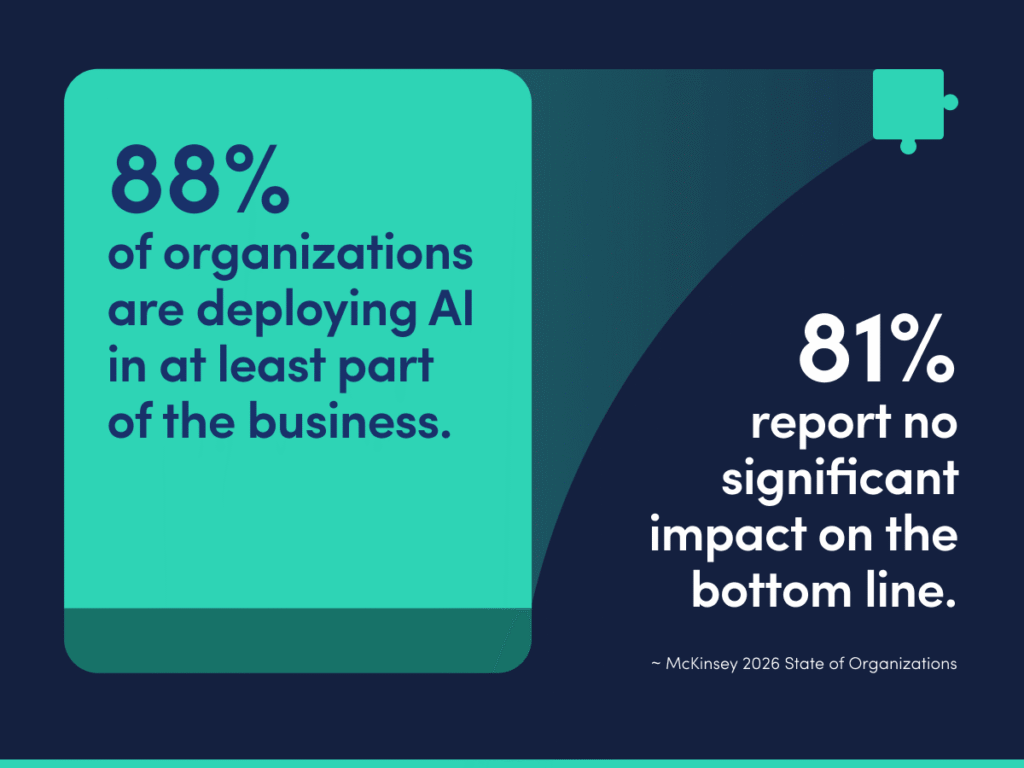
Most companies that have deployed AI can’t prove it’s paying off. McKinsey’s 2026 State of Organizations found that 88% of organizations deploy AI in at least part of the business, yet 81% report no significant impact on the bottom line. Nearly everyone is deploying. Almost no one sees a return.
Even companies with a plan aren’t finding the results they need to justify their AI spend or understand how it impacts the company. KPMG’s Global AI Pulse Q1 2026 found that 95% of organizations have an AI strategy, but only 8% report measurable ROI. A strategy without a way to measure it is just a document.
At the same time, 42% of frontline employees using AI regularly say they’re saving at least a full workday every week, according to BCG’s 2026 AI at Work report. But 66% of them get little or no guidance on what to do with it, and more than half never redirect it toward anything more valuable. The tool worked. Nobody’s tracking where the time went. Is that a measurable gain for your organization?
What’s more, Deloitte’s 2026 Global Human Capital Trends found that 80% of leaders, managers and workers worry their colleagues are using AI to look more productive than they really are.
You can’t prove AI’s return without seeing how it’s used across tools and workflows. Is AI freeing up capacity? Is it changing work behaviors? Is it improving outcomes? You can’t answer any of these questions without behavioral work data.
How does behavioral work data measure AI’s real impact at work?
Most leaders rely on simple, raw numbers to show AI usage in their organization. License counts tell you who has access. Self-reported surveys tell you how people feel about the tool. Neither tells you whether the work itself changed or whether AI is anything more than another search bar.
The ActivTrak Productivity Lab’s 2026 State of the Workplace report finds the average organization now runs seven AI platforms at once, yet only 3% of users reach a productivity sweet spot with them. Those numbers come from seeing how AI actually shows up in the flow of work, not from a survey or a license count.
It’s tempting to blame the tools, models or vendors, but that’s not the real problem. Most organizations can’t see how work happens inside their own walls, so they can’t tell where AI is helping, where it’s stalling or where to deploy it next.
That blind spot is why so much AI investment disappears without a trace. You can’t measure a change you can’t see, and you can’t decide where to apply AI next without a clear baseline of how work happens today.
Deciding where AI is working, and where to deploy it next, is impossible without a clear read on how work happens. The ActivTrak Behavioral Work Dataset is the missing layer beneath every AI governance policy, automation plan and ROI claim.
What is the ActivTrak Behavioral Work Dataset?
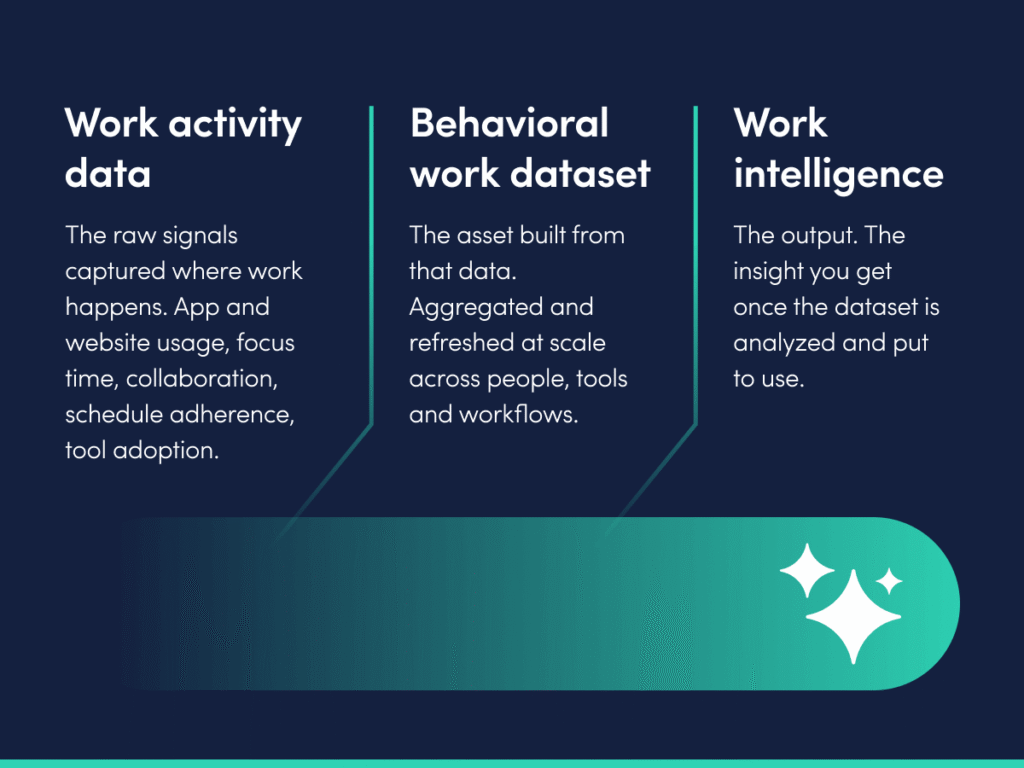
The ActivTrak Behavioral Work Dataset is a continuously updated record of how work gets done across people, tools and workflows. In practical terms, it captures the signals that show how work flows:
- application and website usage
- focus time
- collaboration patterns
- schedule adherence
- technology adoption
- AI adoption and impact
It reflects what happened, not what someone reported in a survey, and more than just license numbers or hours spent in a tool.
It starts with work observability: ActivTrak continuously captures behavioral signals across people, applications, AI and workflows, at the source. That’s the data foundation.
Observability produces work intelligence, the explanation behind the raw signals. Leaders use it to make calls once based on instinct. They interpret the patterns to understand why work looks the way it does.
Using this data, leaders can improve something specific: a staffing plan, a process and an AI workflow. Then they measure whether the change actually moved what it was supposed to.
Most organizations already do half of this. A manager notices a team seems stretched. That’s observing. Leadership changes something, adds headcount, changes a process or brings in a new tool. That’s improving.
What’s missing are the important steps in between and after:
- Interpreting the signal with enough confidence to know what’s actually causing it
- Analyzing the results months later to see whether the change worked or just felt like progress
Most organizations lack the data to make these steps. The ActivTrak Behavioral Work Dataset fills the gap.
How is behavioral work data different from the systems you already have?
Most of what leaders know about their workforce comes from engagement surveys, status updates, self-reported timesheets and the manager’s read of the room. These methods are all filtered through memory, mood and the natural human urge to look productive.
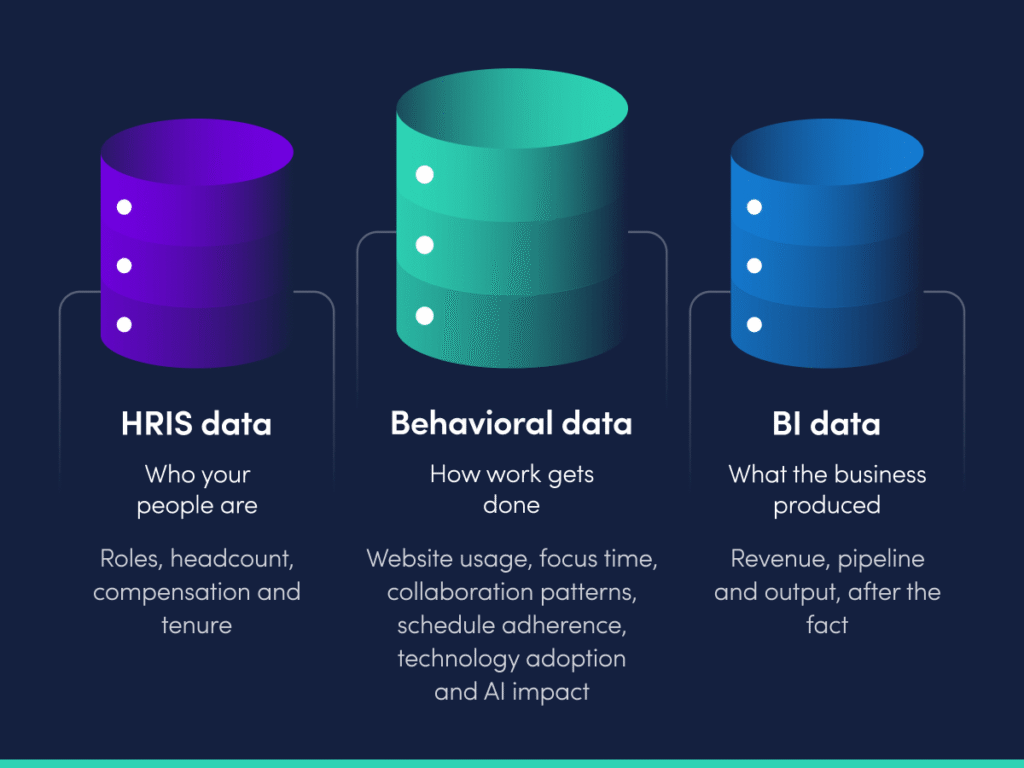
You likely also have several systems that touch work and provide some data, such as an HRIS system showing roles, headcount, compensation and tenure — or your BI stack, which measures business outcomes like revenue, pipeline and output.
None of these shows how the work itself gets done across people and AI.
Behavioral work data comes from a different place. It’s captured continuously from the endpoints where work happens, not gathered in periodic snapshots or recalled after the fact. That single difference changes what the data tells you. It’s objective, current and free from anecdotal bias.
The data reflects what actually happened, not what someone remembers, estimates or hopes is true. When the stakes are an AI strategy or workforce plan, the difference between reported work and real work is the difference between a decision that holds up and one that doesn’t.
Behavioral work data doesn’t replace HRIS or BI, or even your employee engagement surveys. It connects them. Without it, a leader can see headcount go up and revenue stay flat, but nothing about the work in between. The systems report the before and after, and engagement surveys only show you how employees felt about it.
Behavioral data is the only set that shows what changed.
What makes ActivTrak’s behavioral work data different from other options?
Three elements make ActivTrak’s Behavioral Work Dataset hard to reproduce:
1. Scale
Our dataset draws on more than 1 million users across 9,500+ organizations and 23+ industries, with 11 exabytes of work activity data processed every month. That scale turns raw activity into benchmarks you can compare across roles, functions and industries.
2. Breadth
The data spans remote, in-office and hybrid work and captures both digital activity and offline time. It reflects how work happens across people and AI together, not one narrow slice of the picture.
3. Trust
Our dataset is built on a privacy-first architecture that surfaces patterns rather than policing individuals. Trust is not a compliance footnote. Data people don’t trust is data no one acts on.
How do organizations use behavioral work data?
Seeing how work happens matters, but only as a first step. The decision that follows is where the value of ActivTrak’s Behavioral Work Dataset shows up. Organizations use it to guide numerous decisions across people, AI, tools, teams and workflows:
Measure AI’s real impact at work
ActivTrak’s research across 443 million work hours found that among AI users, collaboration rose 34% while focus time fell to a three-year low. The behavioral signals caught AI fragmenting attention, which no license count or survey would show.
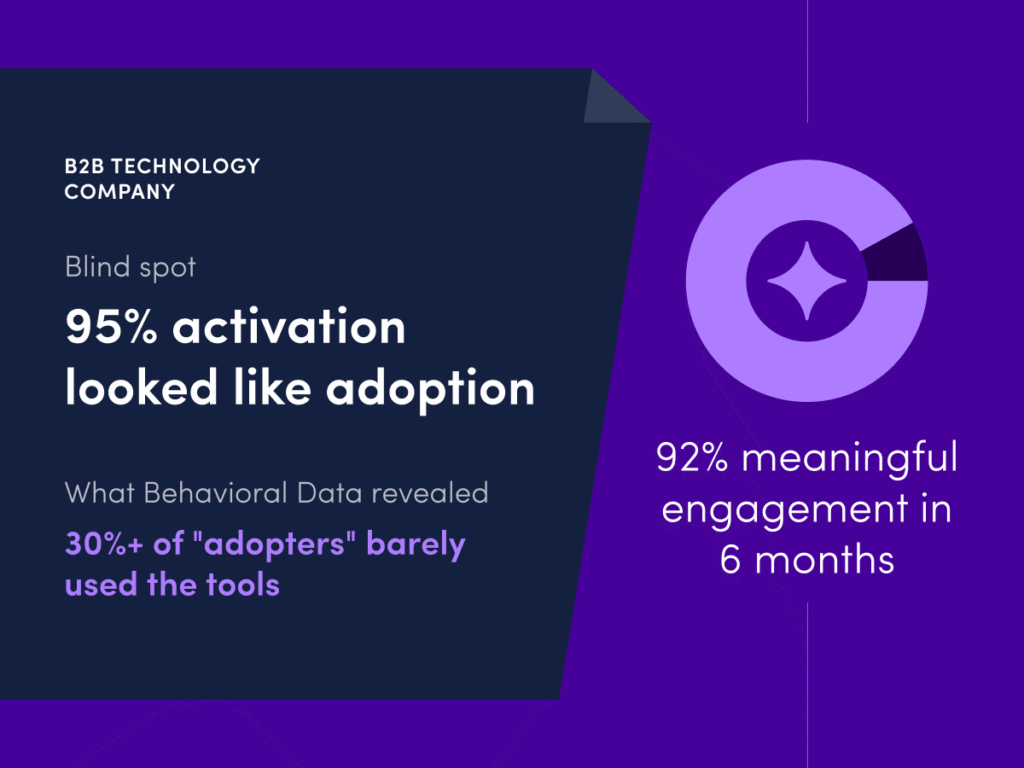
One B2B technology company found this out directly. On paper, AI adoption looked complete: 95% of employees had activated the tools. But behavioral work data told a different story. More than 30% of those “adopters” were barely using anything, sessions too brief to represent real work.
Leadership had been measuring the wrong thing. They shifted from tracking activation to tracking sustained engagement, then mapped every team against the maturity stages in ActivTrak’s Enterprise AI Adoption Maturity Model.
That surfaced the real gaps: Solutions and Engineering were using AI consistently, while Customer Service and Operations showed the widest split between activating a tool and actually working in it.
Find hidden team capacity before hiring
A manager asks to backfill an open role. The team says they’re underwater. The default response is to approve it based on the org chart and a manager’s sense of how stretched things are.
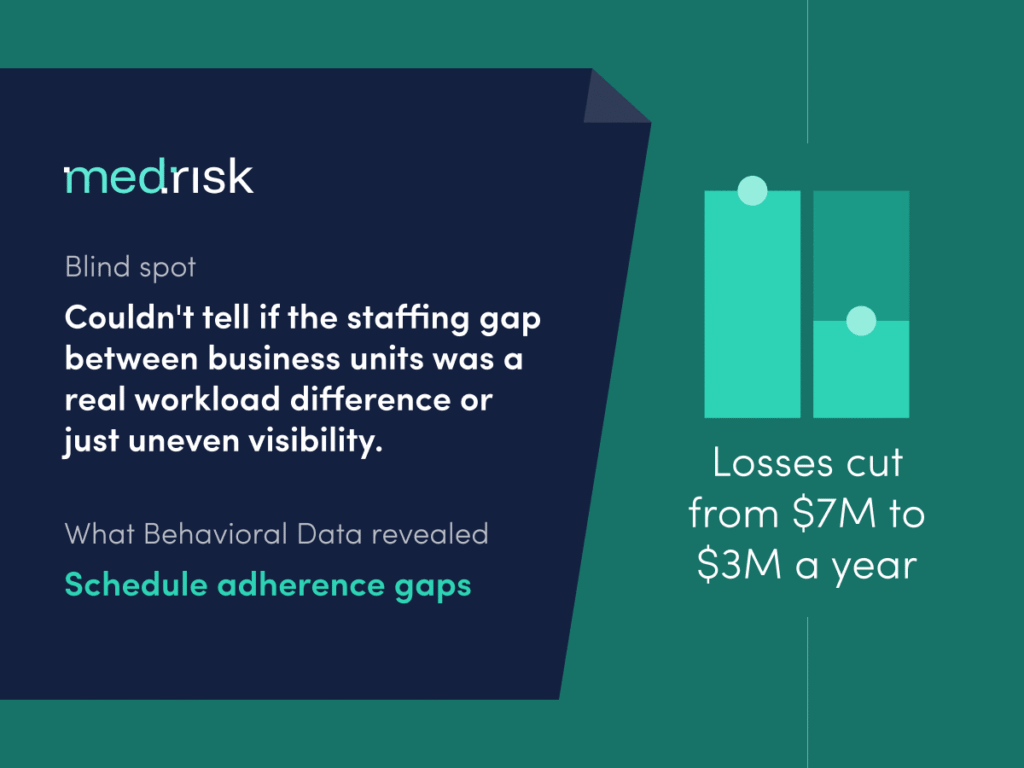
MedRisk, a managed care company with more than 3,200 employees across three business units, hit a version of this problem at scale. As the company grew through acquisitions, leadership couldn’t tell whether staffing gaps between business units reflected real workload differences or just uneven visibility. One acquired entity had close to the same headcount as the parent company but generated very different revenue, and nobody could explain why.
Once MedRisk had a consistent view of activity across entities, that changed. Leaders could see schedule adherence and where expected work and actual work didn’t line up, and why. In their own words, they’d had no way to tell whether someone was working eight hours or sixteen. The result: financial losses that had topped $7 million a year dropped to around $3 million, an 11x return on the investment.
Know if a process is actually working
This example is about how work is organized, and it’s a bigger step because many process decisions go unchecked. A team restructures after a new tool gets funded. The decision gets made once, defended for years, and nobody goes back to ask if it worked because no instrument was built to check.
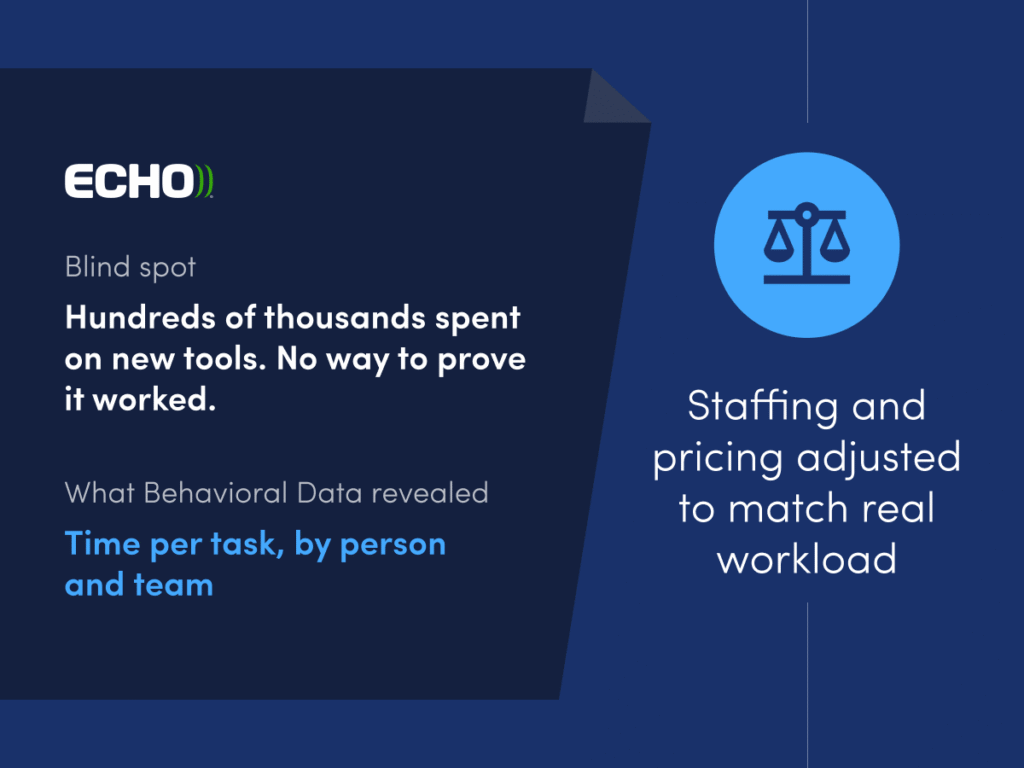
Echo Global Logistics ran into this with an internal technology investment. The company had invested hundreds of thousands of dollars in in-house tools to speed up its brokerage operations, and leadership had one question: Is it actually working? Surveys and manual time studies gave them rough averages, but nothing showed variation between people or teams.
With behavioral work data, Echo built its own measure of time spent per task, by person and by team. This let them see where the new technology was paying off and where it wasn’t. It also allowed leadership to identify which accounts required more effort than others, and to adjust staffing and pricing based on what the work actually required rather than guesswork.
Maintain productivity during times of transition
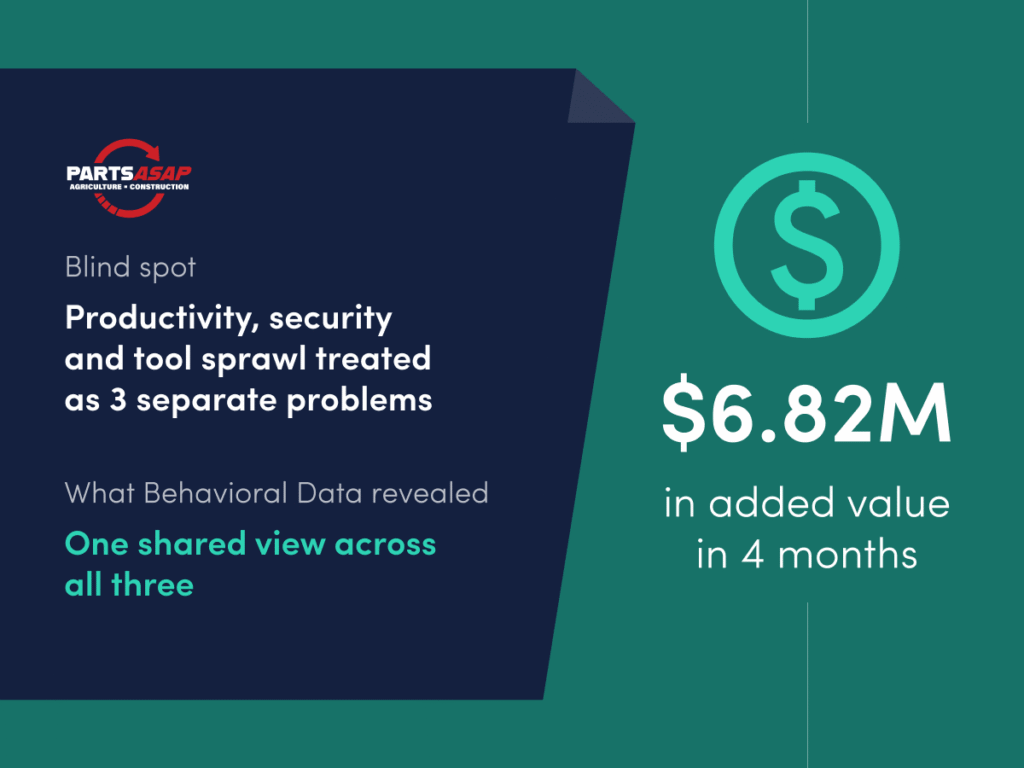
Parts ASAP, a North American equipment supplier, needed to maintain productivity amid 18 acquisitions and a shift to remote work involving 700 employees. Instead of tackling productivity, security and technology consolidation as separate problems, they ran all three through the same visibility at once: coaching based on productivity patterns, tighter oversight on software and security and a clean migration to the tools they wanted teams standardized on.
In four months: a 42% cut in non-productive time, 12,000 additional productive hours a month and $6.82 million in added business value.
How will employees react to having behavioral work data collected?
Many employees may be wary of any program that purports to track their work, but behavioral work data isn’t an intrusive monitoring tool. Instead, this data works at the team level. It shows whether a team’s average time per task is rising by a quarter, not which person took longer on a single ticket. It shows whether focus time across a team is dropping, not which employee was distracted on a given afternoon.
Employee awareness isn’t a compliance checkbox. It correlates with faster improvement. When people know what the organization is measuring and why, the conversation shifts from defensive to constructive.
The data doesn’t change behavior on its own. It gives managers something concrete to build a conversation around, and those conversations are what move the needle.
It’s worth noting that, among leaders who let people go because of AI, more than half now say they question the decision, according to a Forrester report. Acting on an assumption cuts both ways. It can lead to a hire that wasn’t needed, and to a cut that shouldn’t have happened.
Behavioral work data shows how AI is either powering or impeding work, offering a clear path to necessary changes.
Turning workforce data into better decisions on AI
Most leaders can’t answer a basic question about their own organization: How is work actually getting done right now? Most companies don’t have a record.
Behavioral work data doesn’t change anything on its own. Its value is in what you build on top of it: better decisions about AI tools, cleaner AI governance and AI workflows redesigned around how work happens rather than how it’s assumed to happen.
Seeing how work happens matters, but only as a first step. The decision that follows is where the value actually shows up, and that decision is only as good as what it’s built on. Before you can improve how work happens, or prove that AI is improving it, you have to see it. Most organizations still can’t. That’s the gap worth closing first.