

Table of contents
- AI adoption reached 80% and it's accelerating work, not reducing it.
- Tool sprawl is dominant and growing
- There is a productivity sweet spot and most employees aren't in it.
- The workday is shorter. Productive hours are up. Focus is eroding.
- Burnout is down. Disengagement is rising.
- Weekend work has become structural.
- No single work model wins.
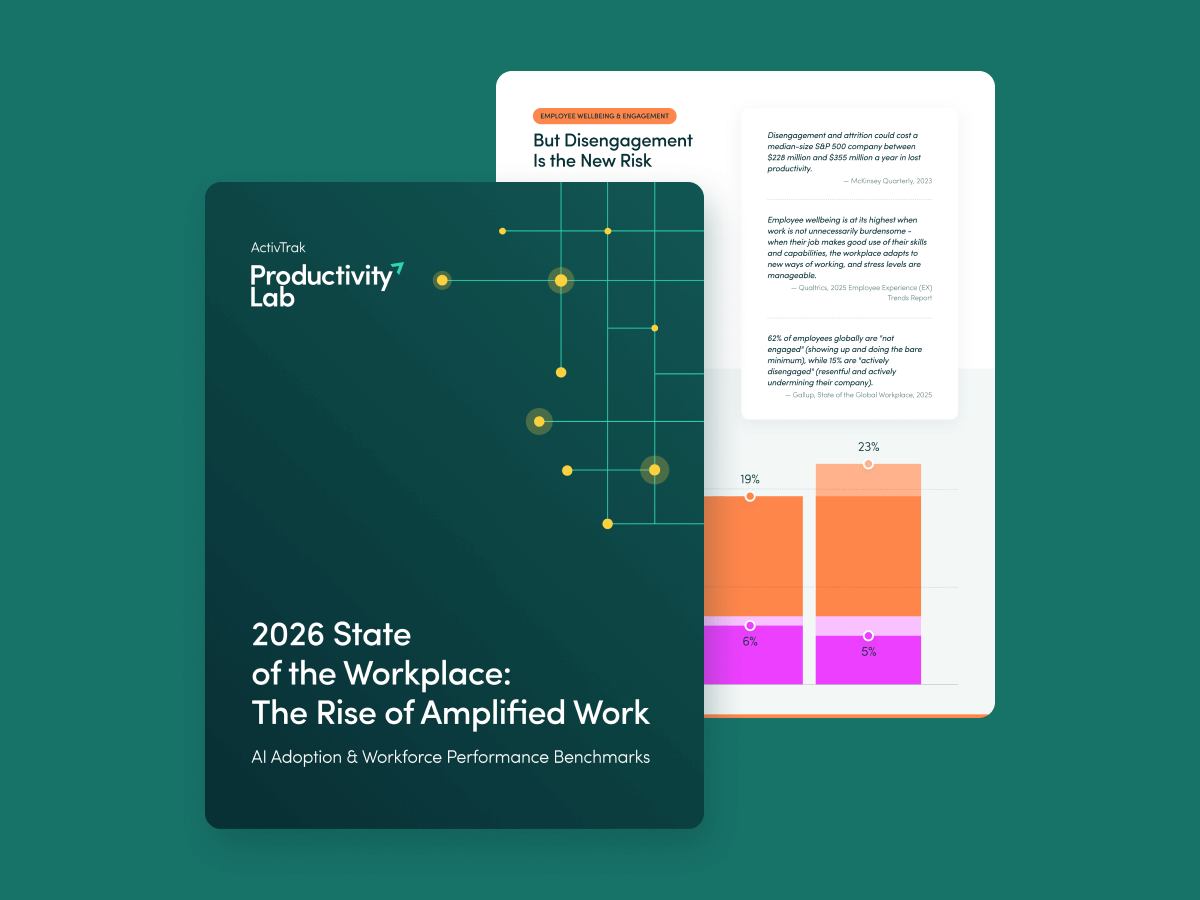
We’re excited to share the fifth annual edition of the Productivity Lab’s State of the Workplace report, The Amplified Workplace: AI Adoption & Workforce Performance Benchmarks. This year’s dataset is our most comprehensive yet: behavioral data spanning three years across 1,111 companies and 163,638 employees, representing more than 443 million hours of actual work across 23+ industries.
The prevailing assumption about AI, and the productivity tools that came before it, is that they make the workday lighter. Shorter. More manageable. The data tells a more complicated story.
AI adoption reached 80% and it’s accelerating work, not reducing it.
Eighty percent of employees now use AI tools, up from 53% just two years ago. Time spent in AI tools increased eightfold. Monthly usage retention averaged 92%, with no single month dropping below 88%, meaning adoption is sticky, not experimental. Thirty-nine percent of AI users have logged usage for 13 or more consecutive months.
The more significant finding: AI is not lightening workloads. Among a subset of 10,584 users comparing behavior 180 days before and after AI adoption, time spent across every measured work category increased. Email went up 104%, chat and messaging increased 145% and business management went up 94%. No activity category decreased after adoption. AI is functioning as an additional productivity layer — not a substitute for existing work.
Tool sprawl is dominant and growing
In 2023, the average organization used 2 AI tools. In 2025, that number reached 7 with 83% of organizations now using 6 or more. Organizations aren’t consolidating around a few trusted platforms; they’re expanding across many. ChatGPT.com became the fifth most-visited website by total hours, up from 19th the prior year, with a 145% year-over-year increase in usage.
This has real implications for governance. When employees work across 7+ AI tools simultaneously, understanding who’s using what (and how) becomes exponentially harder.
There is a productivity sweet spot and most employees aren’t in it.
Employees who spend 7–10% of their total work hours in AI tools have the highest productivity rates (95%) of any usage tier — outperforming both lighter and heavier users. Yet only 3% of employees currently fall within that range. The largest segment (57%) spends less than 1% of total hours in AI.
Most organizations have adoption. Very few have optimized it.
The workday is shorter. Productive hours are up. Focus is eroding.
The average workday shrank from 8 hours 53 minutes in 2023 to 8 hours 44 minutes in 2025. Employees also start earlier as the average first activity shifted from 8:02 a.m. to 7:48 a.m. Despite the shorter days, productive hours increased 5%, rising to 6 hours 36 minutes daily. Productive sessions grew 13%.
But focus efficiency (the share of total work time spent in focused, uninterrupted work) fell to 60%, a three-year low. The average focus session now lasts just 13 minutes 7 seconds, down 9% since 2023. Meanwhile, collaboration surged 34% and multitasking rose 12%. However, what makes the shift in focus time complex is the AI connection. AI could be absorbing the cognitive load that focus time used to carry. Or adding faster, more frequent attention shifts.
Output is up. The conditions that sustain it are eroding, or at least changing.
Burnout is down. Disengagement is rising.
Seventy-five percent of employees maintained healthy work patterns in 2025 — the highest level in three years. Burnout risk fell 22% to just 5% of employees. Overutilization dropped 42%.
At the same time, disengagement risk rose to nearly 1 in 4 employees, up 21% in a single year. These aren’t employees who are checked out. They’re employees whose capacity isn’t being used. Organizations have invested in reducing overload. Fewer have figured out how to actively leverage the capacity that freed up.
While the burnout crisis has eased, the alignment crisis is rising.
Weekend work has become structural.
Saturday productive hours jumped 46%, from 3 hours 10 minutes to 4 hours 37 minutes. Sunday productive hours rose 58%, from 2 hours 30 minutes to 3 hours 58 minutes. Weekend start times are shifting earlier every year: The average Saturday start moved from 8:35 a.m. to 7:11 a.m. — 1 hour and 24 minutes earlier. Sunday starts shifted from 12:24 p.m. to 10:58 a.m.
This isn’t a story about a small group of workaholics. It’s a consistent, three-year structural shift in how weekend time is used.
No single work model wins.
Remote-first companies represent 47% of the location dataset, nearly double the share of office-first (25%) or regular hybrid (25%). Remote-only workers log the highest productive time at 7 hours 1 minute daily. Office-only workers show the highest focus efficiency at 64%. Hybrid workers (those splitting a single day between office and remote) span the longest workdays but log the lowest productive and focused time of any location type.
No single model has a monopoly on performance. What matters more than where employees sit is whether the systems around them are built to support how they actually work.
Three years of behavioral data point in a consistent direction: Work is accelerating faster than the systems designed to manage it. The full report breaks down what’s driving each trend and what leaders should be paying attention to in 2026.
* Work location findings use a location-tagged subset of 401 companies and 130,177 employees