


Every leader has an opinion about where AI should go next. Few have visibility into which workflows are the best candidates for AI, and a reliable way to test its impact. Boston Consulting Group (BCG)‘s report on the widening AI value gap found that only 5% of companies achieve AI value at scale, while 60% report minimal revenue and cost gains from AI despite substantial investment.
That gap is why so much AI investment produces activity without impact — and why the conversation about AI transformation needs to move from “are we using it” to “how do we actually run this process.”
Key takeaways:
- AI transformation starts with visibility, not technology. Understanding how work gets done helps organizations identify opportunities for meaningful improvement.
- The best opportunities emerge at the intersection of people, process and technology. Looking across all three reveals hidden inefficiencies, bottlenecks and automation opportunities.
- Not every workflow problem needs AI. Prioritize solutions based on business impact — whether that means AI, automation, workflow redesign or better use of existing tools.
- Measuring before and after implementation is essential to proving ROI. Establishing baselines and tracking results helps organizations validate improvements and make smarter investment decisions.
- Successful AI transformation is a continuous cycle. Discovering, prioritizing and measuring opportunities creates the evidence needed to drive lasting business value.
The 5 stages of AI transformation
At ActivTrak, we think about AI transformation as a five-stage process: Discover, Prioritize, Act, Measure, Scale. Our role centers on three of those stages:
- Helping organizations discover opportunities within workflows.
- Prioritizing which ones are worth pursuing.
- Measuring whether the changes actually work.
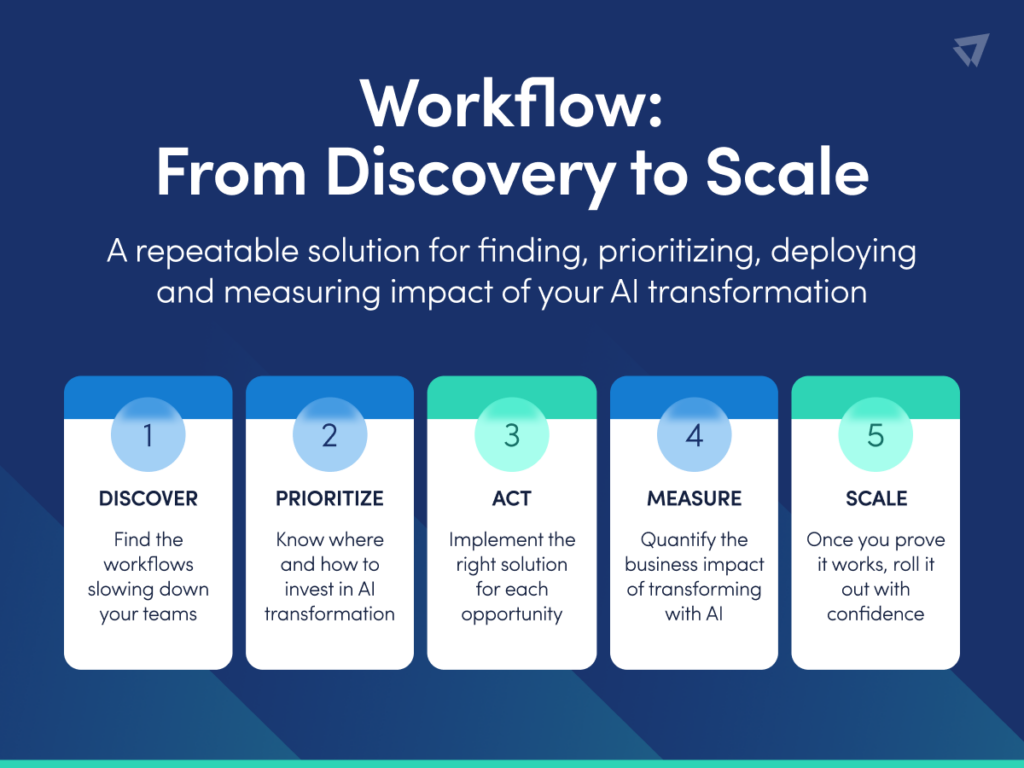
Act and Scale, steps 3 and 5 — implementing automation, redesigning how work gets done and rolling out successful changes — are typically led by the organization and its technology and services partners.
This division lets ActivTrak focus on providing an objective, continuous view of how work gets done. It’s the intelligence organizations need to make better decisions before and after implementation.
Discover: How to identify the right AI opportunities
Most transformation efforts start with a hypothesis, not evidence. A leader has a hunch about which team is overloaded, which process is inefficient or which tool isn’t earning its license fee. Sometimes the hunch is right. Often it isn’t and that’s where AI investment gets misallocated.
The problem isn’t a lack of data. Most organizations have plenty of data about work inside individual systems. What they don’t have is visibility into the work between systems: the handoffs, context switching and workarounds employees build when a process doesn’t fit how the job actually gets done. That’s where time and capacity quietly disappear, and where many of the best opportunities for improvement go unnoticed.
ActivTrak’s work with customers so far shows how significant those opportunities can be: We typically identify 20–30 hours per FTE each month that could be streamlined or automated.
Finding those opportunities requires looking across people, process and technology together.
- People: how teams and roles perform work, including capacity, work patterns and enablement needs
- Process: how work moves from activity to activity, including repetition, friction, bottlenecks, handoffs and unnecessary steps
- Technology: how applications and AI support the work, including adoption, tool fit, integration gaps and automation opportunities.
None tells the full story alone. A process might look inefficient until you see that the technology supporting it is the real bottleneck. A tool might look underused until you see that the workflow around it was never redesigned to take advantage of it. The value is in the intersection, seeing how work gets done across all three, not just what a single system reports.
Prioritize: Know where and what use cases create the most business impact
Discovery produces a list of opportunities. Most organizations have too many and no reliable way to rank them. This is where many AI strategies quietly break down. Leaders need a way to distinguish high-impact opportunities from those driven by the loudest voice in the room.
Then comes the question of what to do about each one. Which repetitive task frees up the most capacity if you fix it? Which bottleneck improves throughput or customer experience if you resolve it? And what’s the right intervention?
AI is one possible answer. So is automation, workflow redesign, a technology change or better enablement for a tool that’s already in place. Not every friction point is an AI problem. Treating AI as the default answer to every inefficiency is how organizations end up with tool sprawl and modest returns.
Prioritization means identifying the intervention most likely to address the underlying cause and deliver meaningful impact.
A recent PwC report found that AI leaders conduct structured reviews of their AI initiatives, deciding what to prioritize, scale or terminate, far more often than others: 56% review prioritization weekly, fortnightly or monthly versus 40% of other companies and 50% versus 34% for scaling decisions.
Measure: Quantify the business impact of AI transformation
Every AI or automation initiative starts as a hypothesis: we think this will improve throughput, reduce manual work or free up capacity. Without a baseline before the change and a comparison afterward, that hypothesis stays a hypothesis. Leadership has a belief, not evidence.
Measurement closes the loop from opportunity to action to proof. It also improves the next round of prioritization. Organizations that measure results learn which interventions actually deliver and where to invest next. Without that measurement, AI ROI remains an open question every budget cycle because nobody can point to what happened last time.
Measurement also turns a one-time exercise into an ongoing system. Each cycle starts with evidence from the last: what actually changed, not what leaders expected to change.
Act and scale: Turn AI opportunities into operational change
Discovery, prioritization and measurement all depend on the same thing: an objective, continuous view of how work gets done. That’s where ActivTrak plays a critical role, providing the work intelligence organizations need to identify opportunities and evaluate results.
Acting on an opportunity — building the automation, redesigning the workflow, running the change management — is a different kind of work. The organization itself or partners who specialize in that execution, such as an RPA vendor, AI agent developer or internal transformation team, usually handle it best.
Scaling what worked is a related but separate discipline: change management, training and rollout sequencing.
Keeping those roles distinct also helps keep the intelligence objective. A vendor that both identifies the opportunity and executes the fix has an incentive to find opportunities that justify what it sells. Separating discovery and measurement from execution keeps the evidence honest and gives organizations a clear way to prove what worked.
That’s the thinking behind ActivTrak Workflow. This solution turns visibility into action, showing organizations where work can improve, where AI belongs and whether the changes they make deliver measurable results. And with each cycle, organizations have better evidence to guide the next one.
Getting the most from AI transformation isn’t about deploying more AI faster. It’s about knowing where it can make a difference and proving that it did.
Ready to find your highest-impact opportunities? Talk to Workflow sales.