

Enterprise AI investments are surging. Yet despite heavy software spending, enterprise productivity across many sectors remains stubbornly flat. Research from BCG shows only 5% of companies gain real value from AI.
The shift to human + AI workflows
Headlines over the last year tell a clear story: Enterprise leaders expect AI to absorb workloads and reduce headcount. The reality has proven far more nuanced.
Early strategies relied heavily on replacing talent, assuming generative tools could manage complex operational tasks independently. Today, 55% of executives regret AI-driven workforce cuts, and Gartner projects that 50% of enterprises that eliminated roles for AI automation will restaff them by 2027.
Replacing experienced employees with bots comes with hidden costs — broken workflows, unexpected failures, more oversight and increased disengagement. Rather than replacing entire roles or tasks, high-performing organizations are shifting their approach. They’re moving beyond AI as a cost-cutting tool and using it to improve how people and AI work together.
The question now is: Where do you start? How do you prioritize the workflows where AI will have the biggest impact?
The hidden drag: Tool friction between systems
Real-world work rarely follows how a process diagram intended it to. In practice, workflows are far more complex and vary widely depending on who’s performing the task. Day to day, employees navigate a web of chat channels, web apps, AI tools, spreadsheets and internal databases. This constant shuffle creates a quiet drag on efficiency.
But the operational friction is invisible to traditional process mining tools, which focus primarily on transaction event logs or click-stream data aimed at replacing tasks with bots. Teams experience this hidden friction through:
- Context switching and attention fragmentation: Bouncing across dozens of disconnected applications disrupts focus and eats up cognitive capacity. Microsoft’s Work Trend Index notes that nearly half (49%) of enterprise AI use is meant to support human problem-solving, yet constant tool jumping undermines that exact focus.
- Manual churn and workarounds: Teams spend hours re-entering data, copying outputs between apps and managing sync spreadsheets when systems don’t integrate cleanly.
- Process divergence and adherence gaps: How team members execute daily work often diverges from official documentation, creating inconsistent outcomes and potential compliance risks.
- Tool misalignment: Deploying technology without clear guidance leads to tool sprawl, low adoption velocity and employee frustration.
Where process mining tools miss the mark
Traditional task mining tools capture desktop click streams to document workflows and isolate repetitive steps, but they miss the broader context of how work gets done. They aren’t designed to measure focus, fragmentation or manager coaching needs. These factors are critical to success, and lasting performance gains usually stem from a balanced combination of process refinement, team enablement, targeted training and smart technology usage.
Unlike traditional mining tools that view work solely through the lens of task replacement, ActivTrak delivers a holistic view across people, processes, and technology. This empowers operational leaders with day one visibility to improve execution, protect team health and maximize technology ROI — without a lengthy or complex implementation.
| Dimension | Traditional process / task mining | ActivTrak work intelligence |
|---|---|---|
| Primary Goal | Build autonomous bots to replace human tasks | Elevate team performance, capacity, and tool adoption |
| Time-to-Value | 6 to 12 months (requires custom ontology mapping) | Day 1 actionable visibility across teams and tools |
| Data Focus | Backend transaction logs (e.g., SAP, Salesforce) | Cross-application workflows, focus time, and workload balance |
| Workforce Impact | Risks employee burnout and operational drag | Protects workforce health, focus time, and manager coaching |
Turn work intelligence into measured impact.
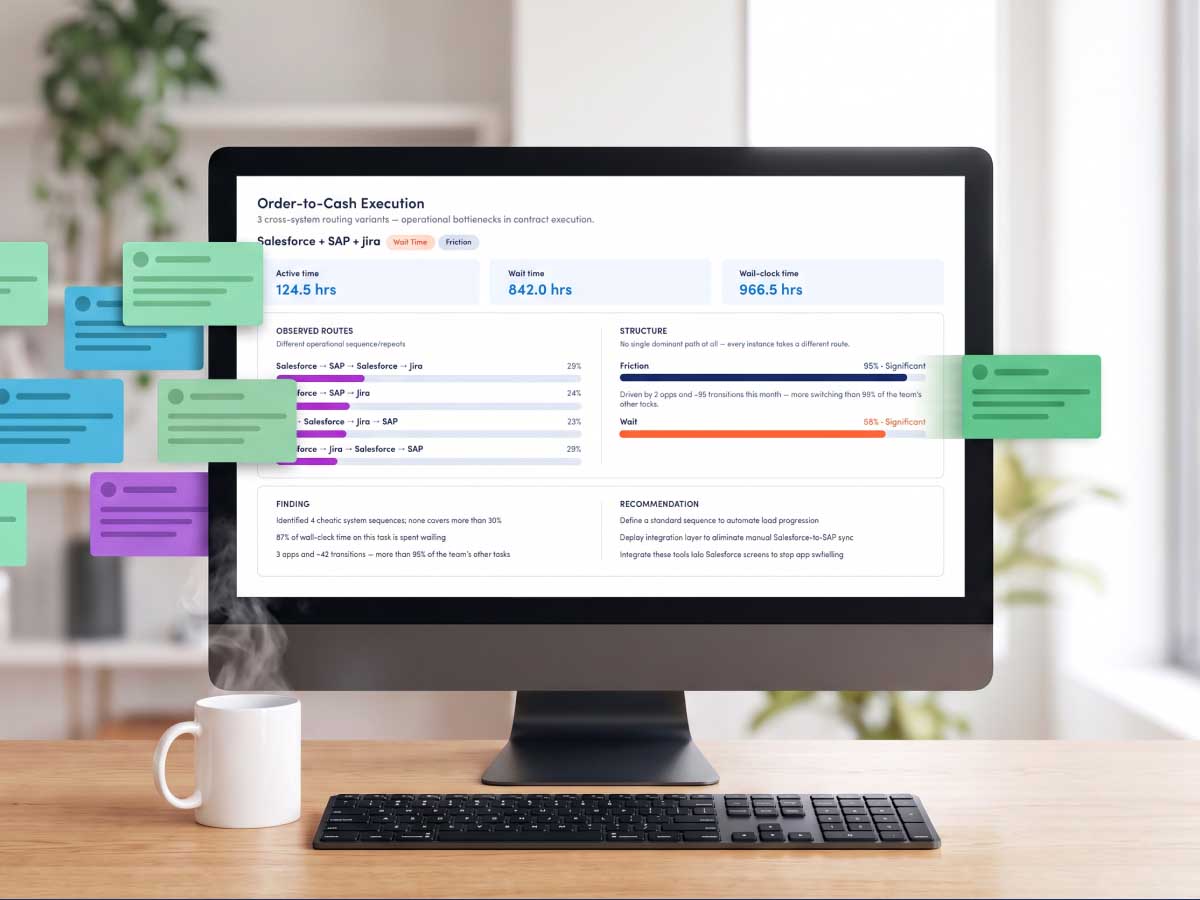
Workflow optimization fails when it relies on guesswork, heavy consulting or static diagrams. ActivTrak Workflow gives operational leaders an instant, dynamic baseline of how people, processes and technology perform together. It cuts through operational noise to deliver data-backed recommendations that protect team capacity and prove hard ROI:
- Automated Workflow & Task Discovery automatically maps how work moves across applications, AI tools and teams to uncover hidden steps, blind spots and informal workarounds.
- Bottleneck & Delay Detection spots high-effort manual tasks, repetitive churn and process delays so you can eliminate friction and protect teams from burnout.
- Automation Opportunity Scoring rates workflows by ROI, potential time savings and setup ease so you can confidently prioritize high-value AI and automation initiatives first.
- Process & SOP Alignment measures actual daily execution habits against official guidelines to eliminate inconsistencies, lower error rates and maintain quality.
- Actionable Step-by-Step Plans translates complex operational data into clear, data-backed recommendations to simplify workflows and guide immediate change.
- Business Impact & ROI Measurement tracks team execution before and after every intervention to prove concrete savings in capacity, efficiency and technology ROI.
Optimize execution, not just technology.
True competitive advantage comes from removing friction and elevating how people and technology perform together. Learn how ActivTrak Workflow helps leaders uncover hidden bottlenecks, protect workforce health and prove real ROI.