


Table of contents
- The gap between AI adoption and enterprise value
- What are the phases of AI adoption maturity in enterprise?
- How should enterprises prioritize AI investments?
- What metrics define enterprise AI adoption maturity?
- The AI enterprise value matrix
- What AI-mature enterprises do differently
- Leading organizations will operate differently
Across industries, organizations are investing billions in AI. Yet many executive teams still evaluate AI like any other technology initiative — with implementation milestones, license counts and usage serving as the primary measures of success.
Those metrics no longer tell the whole story.
Turning AI investments into measurable outcomes requires a new framework for building AI maturity. If you’re familiar with the ActivTrak Enterprise AI Adoption Maturity Model, this is the next step. It provides the operating approach organizations use to advance through all five stages.
The gap between AI adoption and enterprise value
The organizations pulling ahead don’t use more AI. They operate differently. Research from BCG shows only 5% of companies gain real value from AI. These organizations achieve 3.6x higher three-year total shareholder return than laggards. The reason: They systematically build cutting-edge AI capabilities across functions, rather than treating AI like every major technology initiative.
While selecting vendors and tracking adoption are important, this isn’t what drives enterprise value. ActivTrak’s 2026 State of the Workplace research illustrates why. Eight in ten employees now use AI at work. Yet the technology is accelerating work faster than organizations are redesigning it.
AI helps people accomplish more — but it also makes work denser and more complex. When comparing 180 days of work activity before and after AI adoption across 10,584 employees, time spent on other tasks increased:
- Chat and messaging increased 145%
- Email increased 104%
- Business management tools increased 94%
AI doesn’t just introduce new technology. It changes how work is done, how decisions are made and how value is created. Organizations that translate AI adoption into enterprise value do so with an operating model that integrates governance, enablement, prioritization and measurement into a single strategy.
What are the phases of AI adoption maturity in enterprise?
Organizations often assign AI responsibilities across multiple functions. IT manages implementation, legal establishes governance, HR oversees training and department leaders identify use cases. But treating AI as a collection of independent initiatives creates fragmented decision-making and inconsistent results.
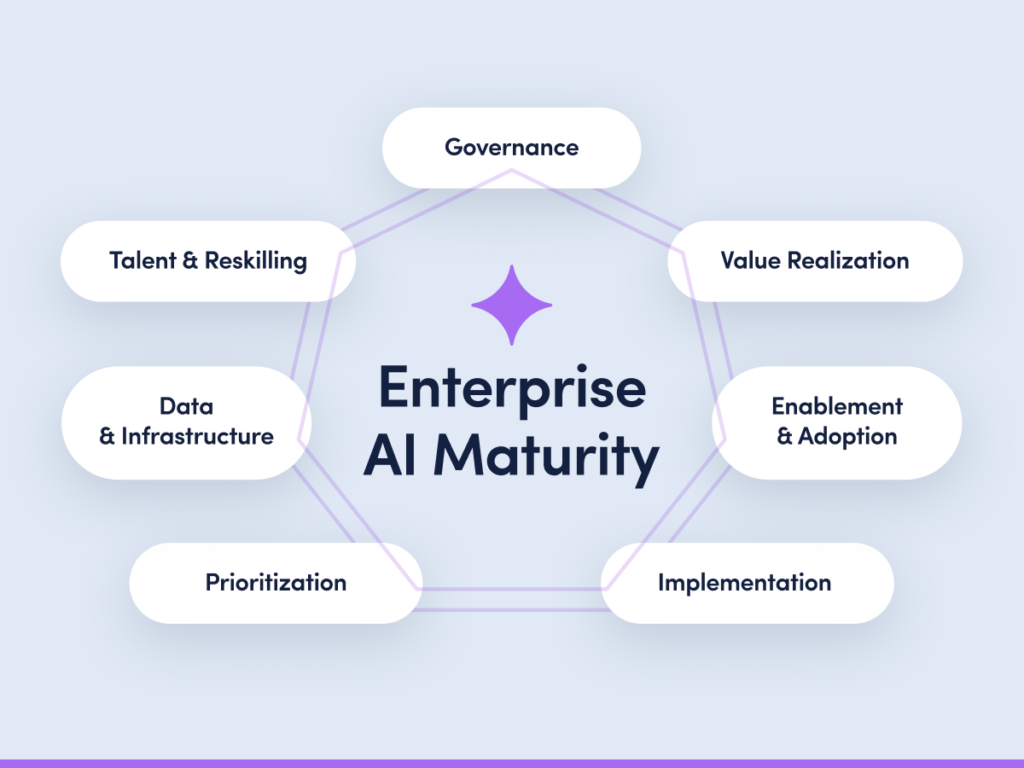
AI-mature organizations take a different approach. They operate through a connected model where each workstream reinforces the others, creating an enterprise-wide system:
| Core Purpose & Function | Enterprise Problem Resolved | |
| Governance | Establish the policies, oversight and accountability that enable responsible AI adoption at scale. | How do we innovate using AI without increasing risk? |
| Value realization | Connect every AI investment to measurable business outcomes before implementation begins. | How do we know this AI investment creates value? |
| Enablement & adoption | Prepare employees and managers to integrate AI into daily work with confidence and consistency. | How do we turn AI access into effective use? |
| Implementation | Deploy AI solutions that integrate seamlessly with business processes and enterprise systems. | How do we integrate AI with business processes? |
| Data & infrastructure | Build the trusted data foundation needed to scale AI reliably. | Do we have the foundation to scale AI with confidence? |
| Talent & reskilling | Redesign roles, skills and leadership capabilities for an AI-enabled organization. | How do we prepare our workforce for AI-enabled work? |
| Prioritization | Prioritize AI investments based on strategic value, organizational readiness and measurable business impact. | Where should we invest next in AI to create the greatest business impact? |
AI-mature organizations approach these phases simultaneously, creating a connected system that continuously improves how work gets done. Governance informs implementation, data strengthens measurement, workforce enablement shapes adoption and value realization guides future investment.
When all seven phases operate as an integrated system, AI is more than a technology initiative. It’s a true competitive advantage.
Research shows the stakes are high. Organizations that actively redesign workflows around AI deliver 22 percentage points more time saved than those that simply deploy tools. Those that prioritize human-AI work design are twice as likely to exceed AI ROI goals. Yet only 36% of employees feel they’ve received adequate AI upskilling — a gap that suggests many organizations are moving faster than their teams can keep pace.
Together, these findings reinforce that enterprise AI maturity depends on more than technology adoption. It requires intentional investments in work design, workforce enablement and organizational change.
How should enterprises prioritize AI investments?
AI maturity isn’t about pursuing every opportunity at once. It requires deliberate investment decisions aligned with business strategy.
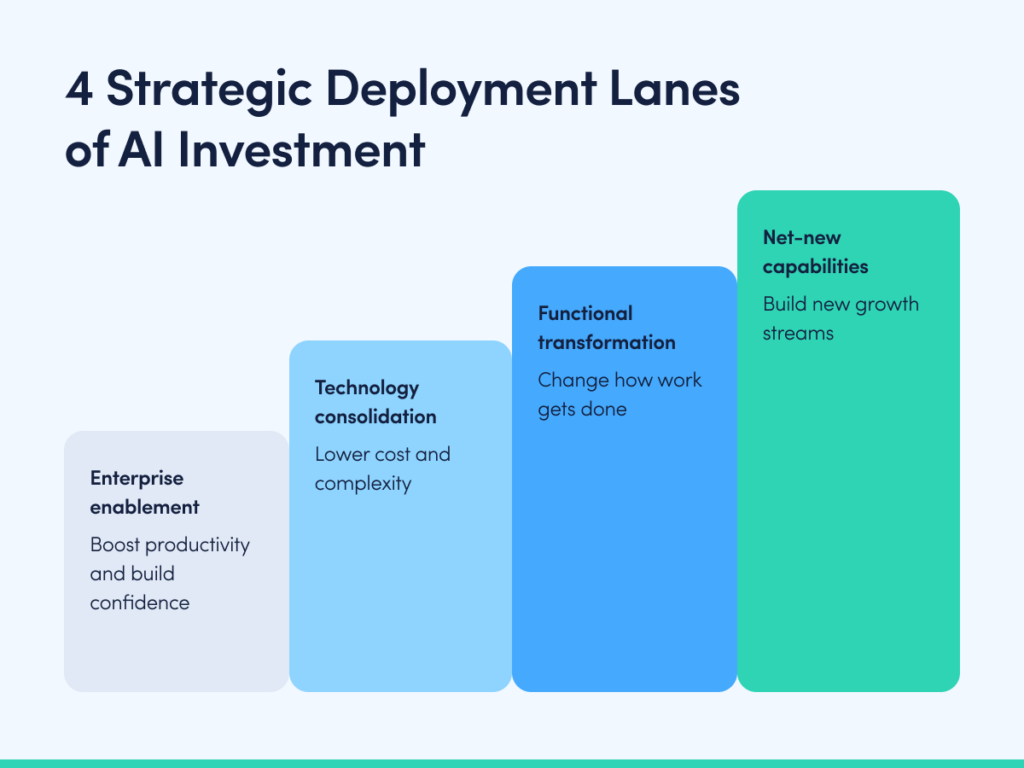
Instead of evaluating individual tools, AI-mature organizations first define the strategic role each investment will play. This creates a common language for prioritizing initiatives, allocating resources and measuring success across the enterprise. Every AI investment typically falls into one of four strategic deployment lanes:
1. Enterprise enablement
Establish a foundation of AI literacy and everyday productivity by providing employees with access to broadly applicable AI tools.
2. Technology consolidation
Reduce software sprawl by replacing overlapping applications with AI-powered platforms that simplify the technology stack.
3. Functional transformation
Redesign high-value workflows within specific business functions to improve capacity, quality and operational performance.
4. Net-new capabilities
Invest in AI that enables products, services or operating models that were not previously possible.
Every AI investment belongs in one of these four strategic lanes. Once each investment has a clear strategic purpose, the next step becomes much simpler.
What metrics define enterprise AI adoption maturity?
Different AI investments create different kinds of value. Measuring them all the same way obscures what’s actually working.
AI-mature organizations establish desired business outcomes before implementation begins, then measure success against those objectives. This creates alignment across business units, clarifies expectations and makes future investment decisions easier. The four most common AI measurement approaches include:
- Output gains: See whether teams produce more work with the same people and resources when using AI.
- Cost savings: Measure reductions in software spend, manual effort or operating costs as a result of AI adoption.
- Quality improvement: Measure improvements in accuracy, consistency, customer experience or operational performance after redesigning workflows with AI.
- New business outcomes: Measure the business impact of capabilities that weren’t possible before AI adoption.
These measurement approaches become even more valuable when they’re applied alongside behavioral workforce data. While understanding what changed is important, seeing how work changed reveals whether AI is delivering the outcomes the business set out to achieve.
For example: When a software company wanted to understand whether AI improved productivity, it combined AI adoption data with behavioral workforce analytics. This allowed leaders to see where employees saved time, how work patterns changed and which teams realized the greatest productivity gains. Measuring business impact allowed the company to create a repeatable framework for evaluating future AI investments.
The AI enterprise value matrix
The AI value matrix combines the four deployment lanes (enterprise enablement, technology consolidation, functional transformation and net-new capabilities) and four AI measurement approaches (output gains, cost savings, quality improvement and new business outcomes). Together, they create a common decision-making framework for leadership across the enterprise.
Here’s an example of what the AI enterprise value matrix might look like in practice:
| Output gains | Cost savings | Quality improvement | New business outcomes | |
| Enterprise enablement | Employees handle more work with AI assistance “We want everyone to use Claude for research and drafts so they can handle higher volume per person.” | Standardize AI assistants across the enterprise “The goal is to reduce overtime by automating routine documentation and reporting.” | Better consistency in everyday work “AI-generated meeting summaries improve documentation consistency across teams.” | Make AI part of daily decision-making “Employees regularly use AI assistants to surface insights that previously went undiscovered.” |
| Technology consolidation | Reduce administrative effort “Consolidating knowledge tools reduces time spent searching for information.” | Eliminate overlapping software licenses “Consolidate chat and ticket tools into a single platform, reducing annual software spend by $800,000.” | Standardize workflows across teams “A single AI platform standardizes customer communications across every business unit.” | Redirect technology budget to strategic initiatives “Savings from software consolidation fund new AI-powered customer experiences.” |
| Functional transformation | Increase team capacity “Finance teams complete month-end close two days faster using AI-assisted workflows.” | Reduce manual review time “Our team automates invoice reviews, reducing billing costs during peak periods.” | Improve error detection “We want to reduce processing errors 20% by automatically flagging duplicate invoices and discrepancies before approval.” | Redesign critical business processes “Self-service insights portal enables business leaders to generate real-time financial analyses without submitting requests.” |
| Net-new capabilities | Automate work that previously required manual effort “Deploy AI agents that independently process routine customer onboarding tasks, doubling the number of accounts activated each day.” | Launch AI-powered self-service experiences that lower support costs “Launch an AI-powered customer support assistant that resolves common issues, reducing support costs by 25%.” | Deliver higher-value customer experiences “Personalized recommendations improve customer satisfaction and retention.” | Launch new AI-enabled products, services or operating models “Launch an AI-powered advisory service that creates a new recurring revenue stream.” |
What AI-mature enterprises do differently
The organizations that create lasting competitive advantage establish an operating model that helps them make smarter decisions, redesign work and measure business impact. While every enterprise journey looks different, the leaders of AI-mature enterprises consistently share several characteristics.
1. Treat AI as a business transformation.
AI-mature organizations align business leaders, technology teams and functional stakeholders around shared priorities, governance and measurable outcomes from the beginning. They treat AI as transformative, rather than another technology initiative.
2. Redesign work.
AI-mature enterprises apply AI to existing processes, rather than focusing solely on new automations. The focus is on improving workflows, increasing capacity and enabling employees to focus on higher-value work.
3. Measure outcomes.
AI-mature organizations define success before implementation begins and measure every initiative against the business outcome it was designed to achieve.
4. Continuously refine.
Leading organizations continuously evaluate where AI creates value, where new opportunities emerge and where investments should be redirected.
Leading organizations will operate differently
The next generation of market leaders won’t be defined by who adopted AI first. It will be led by those who turn AI investments into lasting business results.
Rather than adopting every new capability or deploying more AI tools, focus on building the discipline to govern responsibly, prioritize strategically, measure consistently and continuously redesign work as AI transforms the enterprise.
AI maturity isn’t a destination. It’s an organizational capability that evolves alongside the business. The organizations that invest in developing a strong roadmap today will define the future of work tomorrow.