

Table of contents
Six months into 2026, the corporate conversation around artificial intelligence has shifted. We’re no longer asking if companies will adopt AI, but rather how deeply it’s actually weaving into the daily fabric of work.
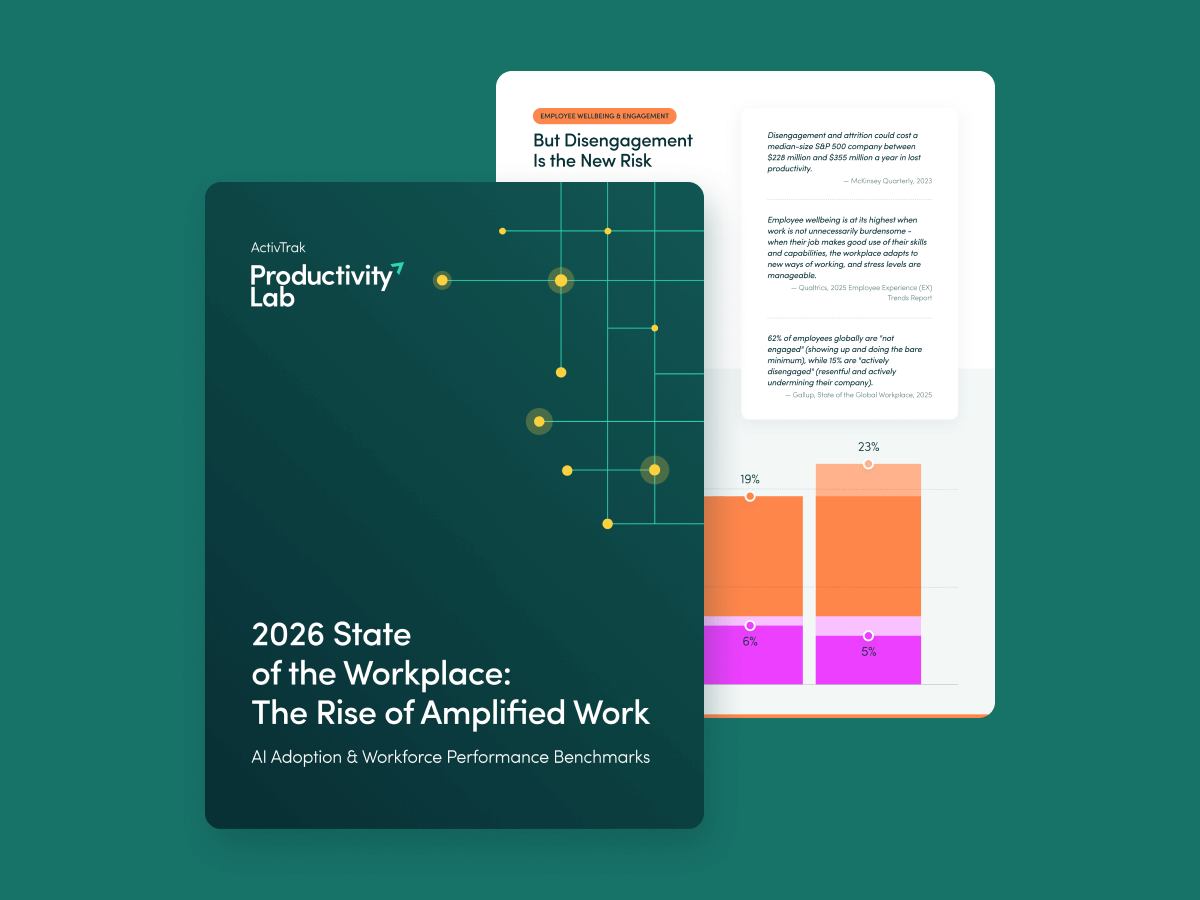
To find out, the ActivTrak Productivity Lab analyzed a continuous cohort of 120,620 users across 1,009 organizations from Q4 2025 through Q2 2026. The data reveals a clear picture: While deep workflow integration is still rare, those who cross the threshold into advanced AI usage are building permanent, highly efficient work habits.
Here are the key takeaways from our mid-year State of the Workforce update.
1. Advanced AI users don’t look back.
One of the most striking findings in the data is the sheer stickiness of advanced AI adoption. Retention among existing AI users sits at a remarkably high 82.2% quarter-over-quarter.
More importantly, once an employee advances past basic tinkering, they rarely look back. Approximately 80% of stage 2 users and 70% of stage 3 users maintain their AI adoption maturity levels quarter-over-quarter. Because advanced adoption forms a permanent habit, every investment in training and enablement for these users continues to pay off over time. Advanced AI adoption isn’t a passing phase — it’s an operationally embedded shift in how work gets done.
2. Deep integration drives shorter workdays.
A common fear is that deep AI adoption will simply lead to a treadmill of overwork, with employees grinding longer hours to produce more output. The data suggests the exact opposite.
While AI users generally outpace non-users in daily productive time (6 hours 34 minutes vs. 6 hours 17 minutes), the deepest tier of AI users optimize their time better than anyone else.
- Stage 2 (task execution) users log an average workday span of 7 hours 5 minutes.
- Stage 3 (workflow integration) users accomplish their deep integration while logging a shorter average workday span of 6 hours 46 minutes.
Stage 3 users also maintain a 69.4% healthy utilization rate — virtually identical to stage 0 non-users (69.2%). This strongly signals that deep AI integration correlates with true work efficiency and time savings rather than burnout and workload expansion. Power users aren’t just working harder. They’re working smarter, achieving high-value work in less time thanks to AI enablement.
3. The gains are a structural lift, not a temporary novelty.
Skeptics often argue that early productivity gains from AI are merely a temporary novelty that decays as initial excitement fades. However, tracking this continuous cohort over three consecutive quarters shows the ~17-minute daily productivity advantage held by AI users has remained remarkably fixed across periods.
This margin demonstrates a clear, persistent correlation between AI engagement and overall productive output, proving the efficiency gains are structural rather than temporary.
4. The AI adoption maturity gap is still wide.
Despite a surge in advanced usage, the vast majority of the modern workforce is still sitting on the sidelines or scratching the surface. In Q2 2026, 84.2% of all employees remain in stage 0 or stage 1 of AI adoption maturity.
While stage 3 users surged by 36.2% from Q1 to Q2 (growing from 1,739 to 2,369 users), they still represent a tiny 2% of the total workforce. This highlights the central adoption challenge facing leadership: Breakthrough growth at the frontier does not automatically move the broader population needle.
Because over 84% of the workforce remains in stages 0 and 1, most organizations are experiencing a bifurcated reality. A small minority of power users is compounding their advantage and accelerating deeper into integrations, while the vast majority of the organization remains stuck using AI as little more than a sporadic search engine. The primary hurdle to scaling organizational AI isn’t making power users more sophisticated — it’s lowering friction to bring early-stage users into active task execution.
Workforce distribution by AI maturity stage (Q2 2026)
Within the context of AI adoption maturity, “dwell time” refers to a user’s active, focused time spent working directly inside an AI application:
| Stage | Name | Core Definition | % of Workforce (Users) |
| Stage 1 | Research assistance | Sporadic use, or regular use with low active dwell time (≤10%). | 26.8% (32,282) |
| Stage 2 | Task execution | Daily use with moderate dwell time, or lower daily interactions. | 13.9% (16,772) |
| Stage 3 | Workflow integration | High frequency daily use, high dwell time (>10%), and frequent interactions. | 2.0% (2,369) |
5. Stage 2 is the sweet spot for healthy balance
Employees who leverage AI for regular task execution registered a 75% healthy utilization rate — the highest of any stage in Q2 2026. These users consistently maintain the healthiest balance of daily activity, maintaining sustainable productive hours each day without veering into exhaustion.
If your organization’s goal is to maximize steady, balanced output, focus on moving people to stage 2.
What this means for leaders: The path to H2 2026
As we look toward the second half of 2026, this mid-year snapshot raises a critical strategic question: Will stage 3 adoption maintain its 36% quarterly clip, or will it hit an organizational ceiling?
To position your workforce on the right side of the curve, focus on two actionable strategies:
- Target the friction, not just the technology: Moving users from stage 1 (research) to stage 2 (task execution) requires deliberate, structured enablement. Don’t just give employees tools. Provide repeatable templates and workflows for specific tasks they can offload to AI.
- Focus on work redesign over working harder: Use your stage 3 power users as internal case studies. Show the rest of the workforce how deep workflow integration leads to shorter, more sustainable workdays rather than an endless treadmill of overwork.