

Do you struggle to govern AI usage? Many leaders do. AI usage is climbing fast, but few companies know how to measure its impact. The result is a widening measurement gap — one that makes it difficult to manage risk, ensure compliance and separate meaningful productivity gains from surface-level activity.
Thankfully, the right data makes effective AI governance possible.
ActivTrak’s fifth annual State of the Workplace report provides important benchmarks to help guide the AI measurement conversation. Here’s what leaders need to know.
80% of employees now use AI tools
That’s up from 53% in 2023. The amount of time spent in AI tools increased eightfold, and 39% of AI users have logged AI time for 13 or more consecutive months since Jan 2024. Meanwhile, the number of AI tools in use jumped from 2 to 7 — and 83% of organizations use 6 or more.
In other words…
The question is no longer: “Are my employees using AI?” Instead, leaders should ask: “How is AI usage changing work?”
It’s an important question to answer, since the reality of AI doesn’t always meet expectations. Instead of making the workday shorter and easier, as many anticipated, AI often adds time and effort — and can even lead to “brain fry.”
Rather than simplifying work as many anticipated, AI tools amplify it. As TechRadar puts it:
“The rapid adoption of Artificial Intelligence created the impression that humans would complete tasks faster and reduce workplace burdens. But new data from the ActivTrak Productivity Lab’s 2026 State of the Workplace analysis claims workplace activity is not shrinking in the way many expected…although the average workday has reduced slightly, by about 2%, the nature of work itself is becoming denser and more fragmented.”
This data reveals a critical need for AI insights. To reap the benefits of AI, leaders must first measure and understand its impact on work.
But 80%+ of companies don’t measure AI usage effectively
So far, AI measurement practices have not kept pace with adoption. Eight in ten leaders surveyed by Thomson Reuters say their organizations either don’t measure the ROI of AI or they don’t know if metrics are collected. In a separate KPMG survey, 78% of leaders agree traditional business metrics are insufficient for measuring AI impact.
At the same time, concerns are mounting. A recent ActivTrak customer survey revealed 47% of leaders struggle to distinguish between hype and actual productivity gains from AI. And one-third worry about data privacy and security.
Across industries, organizations are quick to adopt AI but slow to understand its impact on capacity, focus and productivity. At the ActivTrak Productivity Lab, we refer to this as the AI Measurement Gap.
The good news: There is a way to close it.
How to close the AI Measurement Gap
The AI Measurement Gap is real, and it poses a serious threat to organizations. Expanding AI tool usage without any knowledge of impact is like flying blind on a major business investment. Which is why closing the gap is a central leadership challenge to address immediately.
Proper AI measurement involves more than simply tracking AI usage. Leaders need insights for AI governance — the kind that allow you to align AI investments with measurable business outcomes. The best way to do this? Use workforce analytics to answer key questions including:
- Where does AI actually improve productivity — and where does it add friction?
- How does AI usage impact focus time and attention shifts?
- Which teams or roles see measurable gains from AI adoption?
- Are AI tools reducing workload or increasing task volume and complexity?
- How does AI usage translate to performance, efficiency and capacity?
- What are the potential data privacy or compliance risks?
Answering these questions accurately and thoroughly allows leaders to govern AI with clarity. As AI continues to rapidly reshape how work gets done, such visibility is crucial.
Measure AI impact with ActivTrak
A lack of clear measurement leaves leaders to guess at everything from ROI to security risks. To close the AI Measurement Gap, you need to understand how AI is actually changing work at your organization.
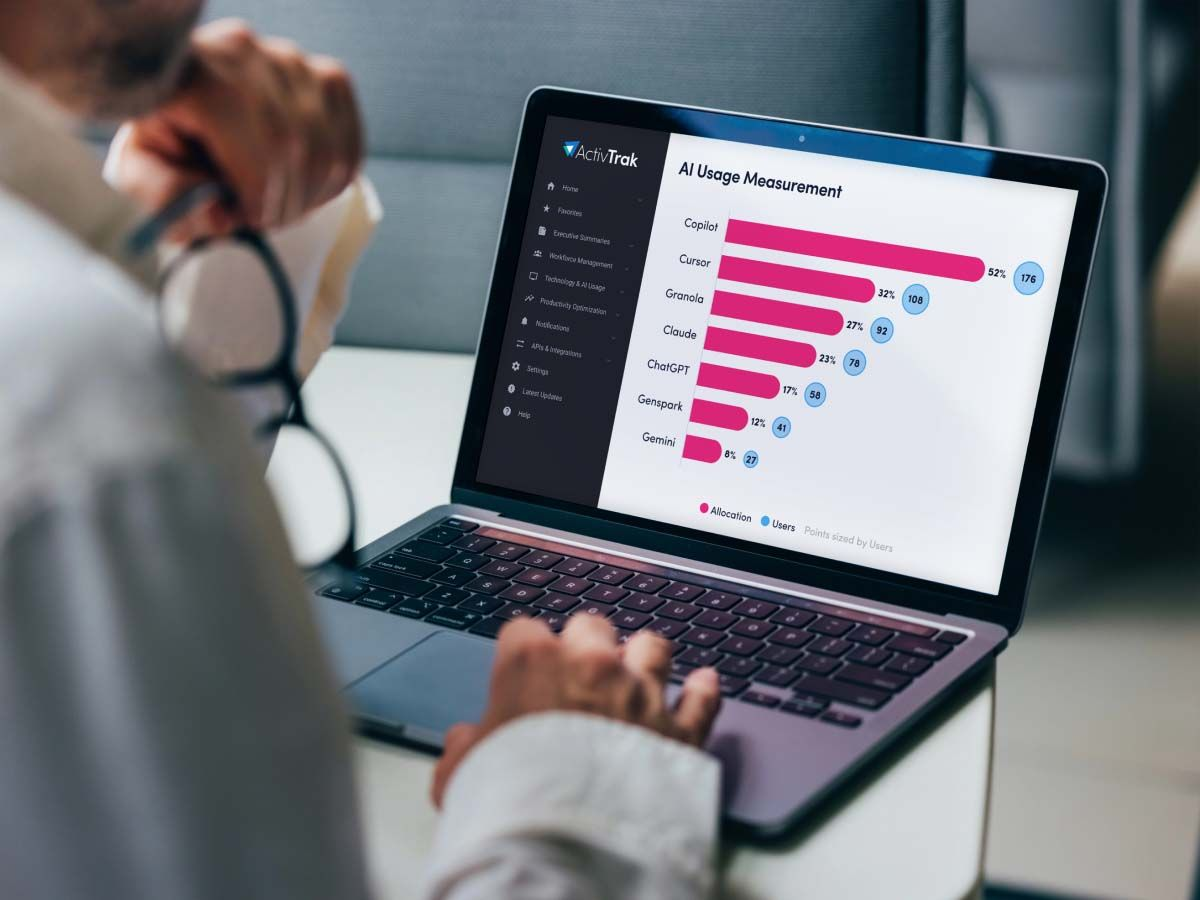
ActivTrak’s new AI Insights add-on brings that clarity into view. This new set of capabilities shows leaders where AI is used, how it’s reshaping work and where it’s creating value. Use it to:
- Track AI usage across teams and tools
- Govern AI usage with clear data
- Measure how AI impacts productivity
- Quantify the ROI of AI across the organization
Ready to bring structure and visibility to your AI strategy? Get in touch to see how ActivTrak helps you measure what matters.